



Solutions explained
Person of contact

Pellegrini Marco
mpe@cefic.beWhy it matters?
Biotechnology is an important part of the bioeconomy. It uses living organisms, such as microorganisms or plant cells, as well as biological processes, to develop and manufacture products and materials.
For the chemical industry, biotechnology can provide new ways to produce chemicals using renewable biological resources and other non-fossil carbon sources. It can also help turn waste and side streams into valuable resources and enable innovative manufacturing processes.
Applications already include the production of enzymes, amino acids, organic acids and pharmaceutical ingredients, as well as processes that use agricultural residues, forestry materials and other biological resources.
Want to learn more about wider bioeconomy? Visit the Bioeconomy policy webpage.
From biomass to chemicals: understanding the bioeconomy value chain
Biotechnology is one of several technologies that can help convert renewable biological resources into chemicals and materials. The infographic below shows the journey from biomass feedstocks through preparation and conversion to chemical production and end-of-life management
BIOECONOMY VALUE CHAIN
how biomass is prepared, converted into chemicals and managed at end of life
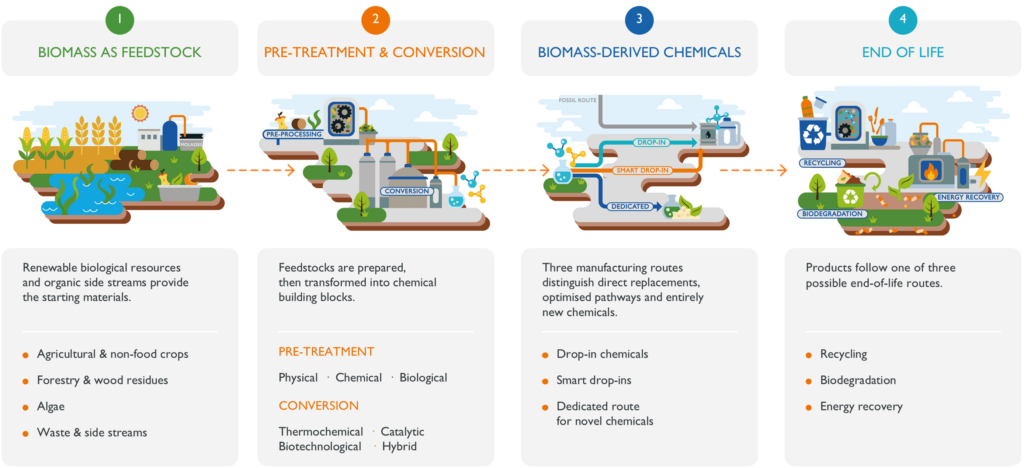
Figure: Bioeconomy value chain — how biomass is prepared, converted into chemicals and managed at end of life.
1. Biomass as feedstock
The process begins with renewable biological resources and organic side streams. These can include:
- agricultural and non-food crops;
- forestry and wood residues;
- algae; and
- waste and side streams.
These resources can provide renewable feedstocks for producing chemicals and materials.
2. Preparing and converting biomass
Before biomass can become a chemical building block, it generally needs to be prepared and converted.
Pre-treatment can involve physical, chemical or biological processes. The subsequent conversion can use thermochemical, catalytic, biotechnological or hybrid approaches.
This is where biotechnology can play a particularly important role. Microorganisms, enzymes and other biological processes can help transform biomass and other raw materials into useful chemical building blocks.
3. Producing biomass-derived chemicals
The infographic distinguishes three routes through which biomass can contribute to chemical production:
- Drop-in chemicals: alternatives designed to replace existing chemicals.
- Optimised drop-ins: chemicals produced through optimised pathways.
- Dedicated routes for novel chemicals: new chemical products enabled through different production pathways.
4. What happens at the end of life?
Producing a chemical from biomass does not remove the need to consider what happens to the resulting product at the end of its life. The infographic identifies three possible routes:
- recycling;
- biodegradation;
- energy recovery.
This shows the bioeconomy as a value chain rather than simply a change of feedstock. It considers not only where the carbon comes from, but also how resources are converted, used and managed throughout the lifecycle.
How biotechnology works in practice?
Using plant residues to produce valuable chemicals
One application involves lignocellulosic biomass, such as residues from agriculture and forestry. This material contains cellulose, hemicellulose and lignin, which can be separated and processed for use in industrial production.
How it works?
- Lignocellulosic material is broken down into its main components.
- Microorganisms can process sugars contained in the biomass, such as xylose.
- These sugars can then be converted into chemicals and other products.
This is an example of the biotechnological conversion step shown in the bioeconomy value chain.
Using microorganisms to capture and use CO₂
Biological Carbon Capture and Utilisation, or Bio-CCU, uses living organisms such as cyanobacteria to capture CO₂ from the atmosphere or industrial emissions and convert it into useful products.
How it works?
- Cyanobacteria absorb CO₂.
- Using sunlight, they convert the CO₂ through biological processes.
- The resulting chemicals can be used in different products.
This is another example of how biotechnology can provide new pathways for chemical manufacturing.
Biotechnology in the chemical industry
Check out examples of how the chemical industry applies biotechnology to its processes


