




Chemical industry snapshot
Updated with 2025 data
The second-biggest industry
With over £66,3 billion of exports and £38 billion of value added to the UK economy, 2025 saw the chemicals & pharmaceuticals industry as the UK’s second largest manufacturing industry behind machinery & transport equipment.
Offering a full product range
The UK industry is active in all key areas: basic inorganics, petrochemicals, polymers, agrochemicals, paints, detergents and personal care products, in specialties such as adhesives, flavours and fragrances, and in a host of industrial specialties including lubricants, fuel additives, construction chemicals and catalysts. It is also a global leader in pharmaceuticals with numerous research centres around the country and a thriving collaboration between academia and industry.
Employing and investing
The UK chemical and pharmaceutical industry has a workforce of over 134,000 people and across the country the equivalent to 45,000 fulltime people work on chemical and pharmaceutical R&D. The workforce is on an average weekly salary of over 25% higher than the rest of the manufacturing sector and nearly 40% higher than the average across the economy.Focusing on the gender breakdown, 35% of the workforce are women above the 26.2% manufacturing average. Chemical and pharmaceutical businesses are also at the heart of multiple high value supply chains and are estimated to support a further 500,000 jobs – many in poorer economic regions of the UK.
The sector is a national leader when it comes to research and development (R&D) spend with an annual investment of almost £10.2 billion which accounts for over 18.4% of the UK’s total business spend.
On top of this spend on R&D, the industry spent a further £6.9 billion in 2025 on business investment into areas such as buildings, vehicles, and machinery. This accounts for 21.7% of private sector manufacturing’s spend.
UK chemical industry performance through 2025
2025 was a particularly challenging year for the chemical sector, with output declining by 3.8%, following a smaller contraction of 0.4% in 2024. After several difficult years, including the disruptions of 2022 driven by the energy crisis, labour shortages, and constrained raw material supply, the industry continued to face persistent cost pressures and growing international competition. Producers in competing regions benefit from significantly lower energy prices and production costs, making it increasingly difficult for UK firms to remain competitive and profitable.
European gas prices remain substantially higher, weakening competitiveness in an industry where energy serves not only as a production input but also as a feedstock. At the same time, the continued expansion of Chinese ethylene capacity, with major additions expected through 2028, is contributing to global oversupply and exerting sustained downward pressure on profit margins. Recent cracker closures across Europe – including two of three in the UK – further highlight the ongoing restructuring of the industry.
The United Kingdom faces additional challenges beyond elevated energy costs. Domestic producers must absorb the financial burden of re-registering substances under the UK REACH framework, while the gradual reduction of free carbon allowances is increasing compliance costs.
In contrast, the pharmaceutical sector performed more strongly in 2025, recording growth of 7.7% following an increase of 0.7% in 2024. Internationally, the UK is currently the only country to have secured a bilateral arrangement with the United States guaranteeing zero tariffs on pharmaceutical exports for at least three years. This agreement strengthens the UK’s position as a preferential European hub for medicinal and pharmaceutical products serving the US market.
Current challenges faced by the industry
The UK chemical industry is facing several current and long-term challenges. The CIA’s quarterly surveys showed that even at the end of the year, weakening demand stood out, ranked by 50% of our members, as the number 1 challenge, followed by energy costs and raw material costs. It is, though, the cost of energy that always features as the key overall challenge. While weakening demand does score the most first-place rankings, energy costs are a more persistent and present widespread pressure across businesses.
2025 has been marked by these pressures, that have continued into 2026 and are now more widespread because of the ongoing pressures on feedstocks.
The Chemical Industries Association survey results for Q1 2026 indicate that conditions have deteriorated further, as 2025 ended. Among survey respondents, 92% reported worsening energy costs, 97% reported worsening raw material costs, and 90% reported worsening freight costs.
Energy Price Increases
At the end of 2025, energy costs remained one of the three most significant challenges facing the UK chemical industry. While wholesale energy prices had fallen from the unprecedented peaks experienced during the energy crisis, UK industrial energy costs remained significantly above pre-2019 levels and substantially higher than those faced by international competitors, particularly in the US and China. High energy costs continue to have a profound impact on the competitiveness of UK chemical manufacturers for several reasons:
- Direct cost: High energy costs continue to undermine the international competitiveness of UK chemical manufacturers. Industrial electricity prices in the UK remain considerably higher than those in many competing economies, including the United States and China, where lower energy costs provide manufacturers with a significant competitive advantage. This cost differential affects investment decisions, discourages domestic production and makes it more difficult for UK businesses to compete in international markets. Despite recent government measures to reduce electricity costs for energy-intensive industries, energy prices remain one of the principal factors affecting the long-term competitiveness of the UK chemical sector. While the British Industry Supercharger provides eligible energy-intensive industries with relief from some electricity network and policy costs, its impact is limited. Support is only available to qualifying businesses, addresses only part of the electricity bill and does not reduce wholesale electricity or gas prices. As a result, many chemical manufacturers continue to face significantly higher energy costs than their international competitors, with energy remaining one of the sector’s principal challenges despite government intervention.
- Indirect – demand: igh energy prices also affect the chemical industry indirectly by weakening demand across the wider economy. Higher energy bills increase costs for households and businesses, reducing disposable income, investment and overall economic activity. As chemicals are predominantly intermediate goods used in sectors such as manufacturing, construction, automotive and consumer products, weaker demand across these industries translates into lower demand for chemical products. According to the latest yearly available data, in 2023, the chemical sector supplied £15.9 billion of intermediate inputs to other industries, with more than 44.2% of chemical output purchased by the other manufacturing sectors, showing its importance as a supplier for the wider economy.
- Indirect – competitiveness: The UK has the highest industrial electricity prices in Europe, around four times higher than those in the United States and Canada. The disparity in energy costs is reducing the UK’s international competitiveness at a time when the UK is reliant on global demand.
Weakening Demand
Weakening demand has become one of the sector’s most significant constraints on growth. While demand has remained subdued across much of UK and European manufacturing, UK producers have also faced persistently high production costs, including energy, labour, raw materials and regulatory compliance. These pressures have reduced the competitiveness of UK manufacturing relative to lower-cost producers in regions such as China, the United States and parts of Southeast Asia, leading some customers to source products from overseas rather than domestic suppliers.
Demand has also been constrained by broader economic conditions. Higher interest rates, subdued business investment and weak consumer confidence have limited activity in key downstream industries such as construction, automotive and consumer goods, all of which are major users of chemical products. At the same time, many manufacturers have continued to keep inventories low, purchasing only when required rather than rebuilding stocks, which has reduced demand for intermediate goods such as chemicals.
International factors have reinforced these domestic challenges. Continued weakness in European manufacturing has weighed on demand for UK chemical exports, while Brexit-related trade frictions and regulatory duplication have increased the cost and complexity of supplying both UK and EU markets. At the same time, relatively high production costs have reduced the competitiveness of UK manufacturers compared with lower-cost producers overseas, particularly in China, the United States and parts of Southeast Asia. As a result, some production and sourcing decisions have shifted away from the UK, limiting demand for domestically produced chemicals, discouraging investment and placing continued pressure on production volumes and profit margins.
Raw Material Costs
At the end of 2025, raw material prices remained one of the principal cost pressures facing the UK chemical industry. Although some commodity prices eased from the exceptional volatility experienced during the energy crisis, businesses continued to face elevated input costs driven by geopolitical uncertainty, supply chain disruptions, higher transportation costs and global trade tensions. As raw materials typically account for a significant proportion of chemical production costs, sustained price increases continued to place pressure on manufacturers’ profitability and competitiveness. CIA business surveys throughout 2025 consistently identified rising raw material prices as one of the sector’s most significant challenges
Direct cost: Raw materials and feedstocks represent one of the largest cost components for chemical manufacturers. The industry relies heavily on hydrocarbon feedstocks, including natural gas, ethane, naphtha and crude oil derivatives, which are used both as sources of energy and as the fundamental building blocks for manufacturing thousands of chemical products. Prices for these inputs are influenced by global commodity markets, geopolitical developments, exchange rates and transportation costs. Increasingly, environmental and climate policies including carbon pricing and regulations supporting the transition to lower-carbon production also influence the cost and availability of certain feedstocks. Together, these factors have continued to place pressure on production costs and profit margins across the UK chemical industry.
Indirect – wider economy: Rising feedstock costs are transmitted through the wider economy because chemical products are intermediate goods used in almost every manufacturing sector. Higher costs for key feedstocks such as natural gas, ethane and naphtha increase the cost of producing chemicals, which in turn raises input costs for industries including agriculture, pharmaceuticals, construction, automotive and consumer goods. This can contribute to higher inflationary pressures and reduce the competitiveness of UK supply chains.
Mid-to-Long Term Challenges
In the mid-to-long term the industry faces challenges surrounding UK REACH which could generate one-off costs of approximately £2 billion for industry by 2030 (a number now claimed by the UK Government to have been reduced to £600 million, following consultation with industry), the net zero transition, and lack of tangible support from government. After the lack of tangible support from Government, an industrial strategy was published in 2025 which did acknowledge the chemical industry as a key foundational sector, but implementation of the strategy is still required.
Revitalising pharmaceuticals
The UK has a well-established life sciences sector, underpinned by leading universities, a strong scientific research base and globally recognised pharmaceutical companies. The sector is one of the UK’s most research-intensive industries, with pharmaceutical R&D accounting for 17% of total UK business R&D in 2023, while medicinal and pharmaceutical products were the UK’s third largest goods export by value in 2024.
Following decades of strong growth, UK pharmaceutical manufacturing weakened between 2009 and 2014 as companies restructured global operations, responded to patent expiries and rising costs, and increasingly relocated manufacturing to lower-cost locations overseas. Production of active pharmaceutical ingredients (APIs) in particular shifted towards countries such as India and China, while Ireland became an increasingly important manufacturing hub within Europe. Although the UK retained its strengths in pharmaceutical research and innovation, domestic manufacturing capacity came under pressure.
In recent years, there has been renewed emphasis on strengthening UK pharmaceutical manufacturing. The Covid-19 pandemic exposed the vulnerabilities of complex global supply chains, while wider geopolitical uncertainty has reinforced the importance of improving domestic resilience for critical medicines and reducing reliance on imported API’s.
Responding to these challenges, the UK Government has placed life sciences at the centre of its Industrial Strategy through the publication of the Life Sciences Sector Plan. Backed by more than £2 billion of government funding over the Spending Review period, the strategy aims to strengthen pharmaceutical manufacturing, research, clinical trials, regulation and commercialisation, while supporting greater adoption of digital technologies and artificial intelligence. Developed in collaboration with more than 250 organisations across industry, healthcare and academia, the plan seeks to enhance the UK’s competitiveness, attract further investment and establish the UK as Europe’s leading life sciences economy by 2030 and by 2035, the third most important Life Sciences economy globally, behind the US and China.
This renewed focus is already being reflected in investment. GSK has announced a £400 million investment in a new global R&D centre on the Cambridge Biomedical Campus, while AstraZeneca has committed £300 million to expand its Cambridge headquarters and modernise manufacturing facilities in Macclesfield. More broadly, the Government reports that the Life Sciences Sector Plan has helped attract more than £3 billion of public and private investment during its first year.
The UK’s international competitiveness has also been strengthened through a new pharmaceutical partnership with the United States, maintaining tariff-free access for UK pharmaceutical exports while promoting closer cooperation on innovation, regulation and supply chain resilience.
The pharmaceutical sector performed more strongly in 2025, recording growth in output of 7.7% following an increase of 0.7% in 2024. Since the Covid pandemic, UK pharmaceutical output has increased by 45.6%. Internationally, the UK is currently the only country to have secured a bilateral arrangement with the United States guaranteeing zero tariffs on pharmaceutical exports for at least three years. This agreement strengthens the UK’s position as a preferential European hub for medicinal and pharmaceutical products serving the US market.
Despite these positive developments, challenges remain. The UK continues to face intense international competition for pharmaceutical manufacturing investment, while skills shortages, high energy costs and the need for continued investment in advanced manufacturing technologies and infrastructure remain significant constraints. Addressing these challenges will be essential if the UK is to convert its world-leading research capabilities into greater domestic manufacturing capacity.
Strong in the North
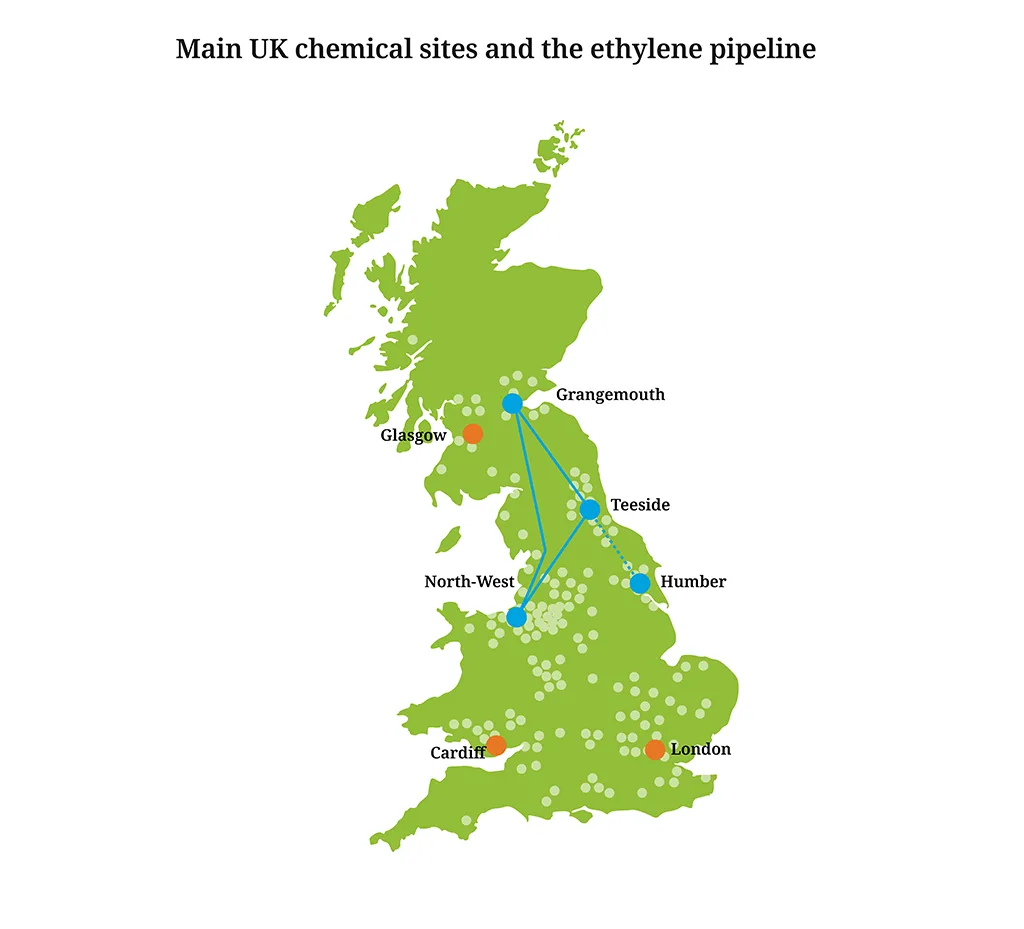
There are chemical manufacturing sites in all UK regions. Primary commodity chemicals are produced mainly in Scotland and Northern England. Feedstocks include hydrocarbons (mainly gas and refined petroleum fractions), minerals and vegetable or animal-derived oils and fats.
Clustered
Sequential processing is the norm, with co-located processing clusters adjacent to industrial customers in other industries.
In the UK we have five main chemical clusters: Grangemouth, the Humber, the North West, Southampton, and Teesside. In these locations there is a higher concentration of chemical companies and transport access.
Close to feedstocks
Chemical manufacturing in the UK is geographically concentrated in industrial regions with strong access to feedstocks, infrastructure, and established supply chains. Based on regional Gross Value Added (GVA), North West England is the leading chemical-producing region, contributing approximately £6.7 billion and accounting for around 20.4% of UK chemical industry GVA. Other major centres include East of England (£4.3 billion), South East England (£4.1 billion), Yorkshire and the Humber (£3.6 billion), and North East England (£3.1 billion). These regional concentrations reflect historical proximity to key feedstocks such as North Sea hydrocarbons, salt, limestone, and energy resources, alongside access to ports, refining infrastructure, and integrated industrial clusters.
Close to ports
Though peripheral to the centre of the European market, many of the chemical-producing regions have access to an ethylene pipeline network, while Liquefied Natural Gas (LNG) re-gasification terminals complement natural gas supplies from the North Sea and Europe. The UK has established 12 Freeports across the country. The Freeports offer tax and employment advantages to business within scope.
Investing for the future
Over recent years, the import of cheap ethane from the US, landed in Grangemouth and Teesside, has helped underpin viability of the UK’s petrochemical industry.
DSM-Firmenich are investing over £100 million to build a large-scale production plant in Dalry, North Ayrshire, Scotland. This project manufactures Bovaer®, a specialized feed additive designed to reduce cow methane emissions by roughly 30%.
In a joint investment with Government, Ineos is spending £150 million on improving energy efficiencies, reducing carbon emissions and increasing productivity at Grangemouth. This will help to secure the site’s long-term competitiveness and sustainability.
Building on knowledge
Speciality chemicals and pharmaceuticals are more widely distributed. In recent years pharmaceutical R&D has increased in South-East and Eastern England, close to the renowned universities of Oxford and Cambridge.
How are we doing?
/
Strengths
- Ethane import infrastructure and a crackers able to use ethane as a feedstock
- LNG import and re-export facilities
- Several closely integrated clusters
- An extensive ethylene pipeline network
- Modern chlor-alkali and derivatives production based on membrane technology
- Strong exports to geographically diverse markets
- High resource efficiency
- Strong pool of highly-skilled researchers and staff
- Highly innovative, backed by exceptional research and university infrastructure
- Good labour relations
- Strong safety and responsibility culture and performance in production and distribution
- Able to satisfy sophisticated consumer demands
- Improving public perception
- Heightened political recognition and value driven by industry’s criticality to the economy and broader society in tackling Covid-19
Challenges
- Ongoing disruption linked to Brexit and the medium to long-term impact on investment
- Uncertainty over the design and implementation of UK REACH
- Fragmented ownership of plants within clusters can lead to non-optimal long- term strategies
- Energy prices are globally uncompetitive, driven up by EU and UK climate policies while US, Middle East and China rivals access cheap hydrocarbons
- Mature European market: growth is faster in Asia and the US
- Scarcity of skilled craft workers because of ageing workforce and competition from other sectors
- Demand remains low after over 2 years of contraction
- High production costs (energy, cost of labour, raw materials, trading) relative to emerging markets hinder international competitiveness
- Historic strength in some key customer industries – e.g. aerospace and automotive – now challenged by ongoing Brexit disruption and stronger growth in non-European markets
Resilience
A key and emerging theme has been the importance of the UK chemical sector to the Country’s resilience.
Like other countries, the UK chemical industry is a key part of the country’s economic and national resilience because it supports many other essential industries and services.
Its importance includes:
- Healthcare: It produces ingredients for medicines, disinfectants, medical plastics, and gases used by the National Health Service.
- Food security: Chemicals are used to manufacture fertilizers, crop protection products, food packaging, and cleaning products, helping ensure a reliable food supply.
- Energy transition: The industry supplies materials for batteries, wind turbines, hydrogen technologies, carbon capture, and insulation needed for net-zero goals.
- Manufacturing: Sectors such as automotive, aerospace, construction, electronics, and consumer goods all rely on chemicals, plastics, coatings, adhesives, and composites.
- Water and environmental protection: Chemicals are essential for water treatment, wastewater purification, pollution control, and recycling processes.
- National security and defence: The industry provides specialist materials, fuels, explosives precursors, protective equipment, and decontamination products used by defence and emergency services.
- Economic resilience: The UK chemical sector contributes tens of billions of pounds to the economy, supports hundreds of thousands of jobs directly and indirectly, and is a major exporter, strengthening supply chains across the country.
- Supply chain resilience: Maintaining domestic chemical production reduces dependence on overseas suppliers for critical materials, making the UK more resilient to global disruptions such as pandemics, geopolitical tensions, or shipping delays.
The Government acknowledges that the chemical industry is considered critical national infrastructure because many sectors—including healthcare, food, energy, defence, water, and manufacturing—depend on a secure and reliable supply of chemical products. A resilient UK chemical industry helps ensure the country can respond effectively to emergencies while supporting long-term economic growth and technological innovation.
A sign, but we believe it can only to be a first sign, the Government announced a £350 million Critical Chemicals Resilience Fund to assist or support strategically important producers and sites, related supply chains and clusters regions and with it, thousands of skilled jobs. We have welcomed this step forward, but it remains only one step and we continue to work with Government to look at affordable ways of making the whole industry more secure.
Our contribution to a competitive Europe
Putting science to work
The UK government wants the UK to be the world’s most innovative economy and through the Industrial Strategy, has committed to reaching the target of 2.4% of GDP investment in Research and Development (R&D) by 2027. This objective As a first step to reaching the target, the Government announced an additional investment of £7bn for R&D over 5 years (from 2017-18 to 2021-22) as part of the National Productivity Investment Fund. This raises public investment in R&D from around £9.5bn per annum in 2016-17 to around £12.5bn per annum in 2021-22 – the biggest ever increase in public funding of R&D.
Navigating Brexit
With 48% of UK chemical exports destined for the EU and 65% of chemical imports originating from the EU, it was very reassuring that tariffs were avoided and supportive Rules of Origin agreed as part of the UK/EU Trade and Cooperation Agreement.
Nevertheless, a decade after the vote to leave the European Union, the UK is still to fully establish UK REACH.

