




Chemical industry snapshot
Updated with 2025 data
A strategic sector for the Spanish economy
The chemical industry – covering both chemical and pharmaceutical activities under NACE codes 20 and 21 – is one of Spain’s largest, strongest and most resilient industrial sectors, playing a key role in the development of an advanced economy through its contribution to wealth creation and high-quality employment.
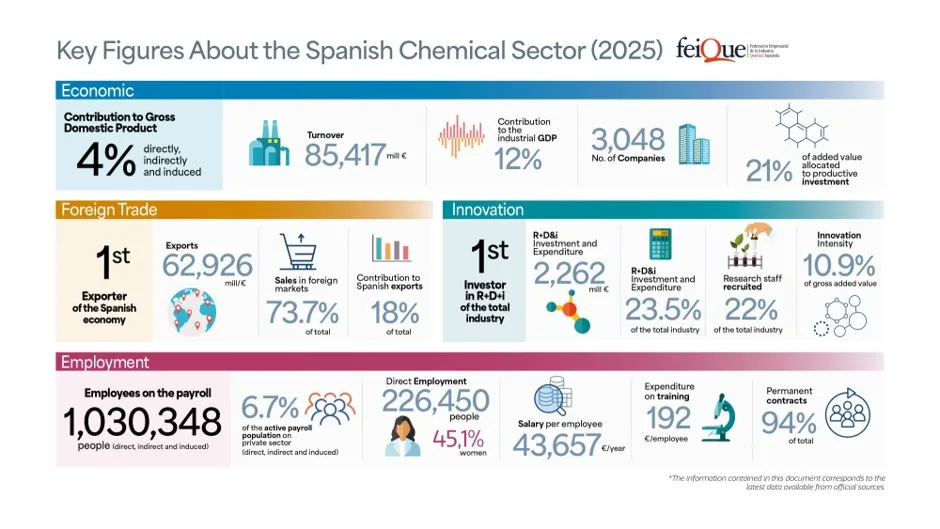
It accounts for 12% of industrial GDP – including indirect and induced effects – and represents 6.7% of the private-sector salaried workforce. With turnover of €85.417 billion, 73.7% of which is generated in foreign markets – amounting to €62.926 billion – the chemical sector is Spain’s top industrial exporter and the leading industrial investor in R&D and innovation.
The sector also has a significant multiplier effect on the Spanish economy. It is the second-largest sector in terms of added value contribution, with every euro of direct gross value added generated by the chemical industry multiplying to €2.75 across the economy as a whole. Overall, this represents €57.1 billion, equivalent to 4% of GDP.
Resilience amid competitiveness challenges
The Spanish chemical industry closed 2025 with a slight contraction of -0.1% in turnover, driven by a price adjustment (-1.6%) that offset growth in production (+1.3%). Weak demand in Europe, together with growing international competitive pressure and trade tensions, has weighed on prices.
The sector continues to face significant competitiveness challenges, particularly in basic chemicals, which since 2020 has experienced a marked slowdown due to high energy costs compared with the United States and China. Basic chemicals account for one third of the sector’s output and are essential to the functioning of numerous value chains.
In this context, the sector’s productive growth continues to be supported by segments such as consumer chemicals, specialties and pharmaceutical chemicals, which are showing greater resilience in the current economic environment
Stable, skilled and diverse employment
The chemical sector is also an example of a strong industry capable of generating high-quality employment in terms of both wages and stability. It provides direct employment to 226,450 people, a figure that exceeds one million when indirect and induced jobs are included, equivalent to 6.7% of the country’s salaried workforce.
Regarding job stability, the Spanish chemical industry continues to stand out for the quality of the employment it generates, with 94% of contracts being permanent.
Leading industrial innovation
Innovation remains one of the chemical sector’s main pillars of competitiveness. With annual investment of €2.262 billion in R&D&I, excluding purchases, the chemical industry is Spain’s leading industrial investor, accounting for 23.5% of the total.
In addition, more than one in five private-sector researchers and technicians engaged in innovation activities work in this sector (22%), further reinforcing its role as a technological driver for the country.
This commitment to innovation is directly linked to the achievement of decarbonisation, circular economy and digitalisation goals. As an essential supplier to 98% of productive sectors, the chemical industry is present across numerous value chains, developing technological solutions that improve process efficiency, reduce energy consumption and support the transition towards climate neutrality.
Main Production Areas
Catalonia region accounts for 43.9% of Spain’s chemical production.
Tarragona, located in southern Catalonia, is home to one of the largest petrochemical clusters in Southern Europe, accounting for 25% of Spain’s chemical production. The site produces around 21.7 million metric tonnes (MMT) per year and employs 5,500 people, while generating more than 40,500 jobs in related activities. It is closely linked to local universities and research centres.
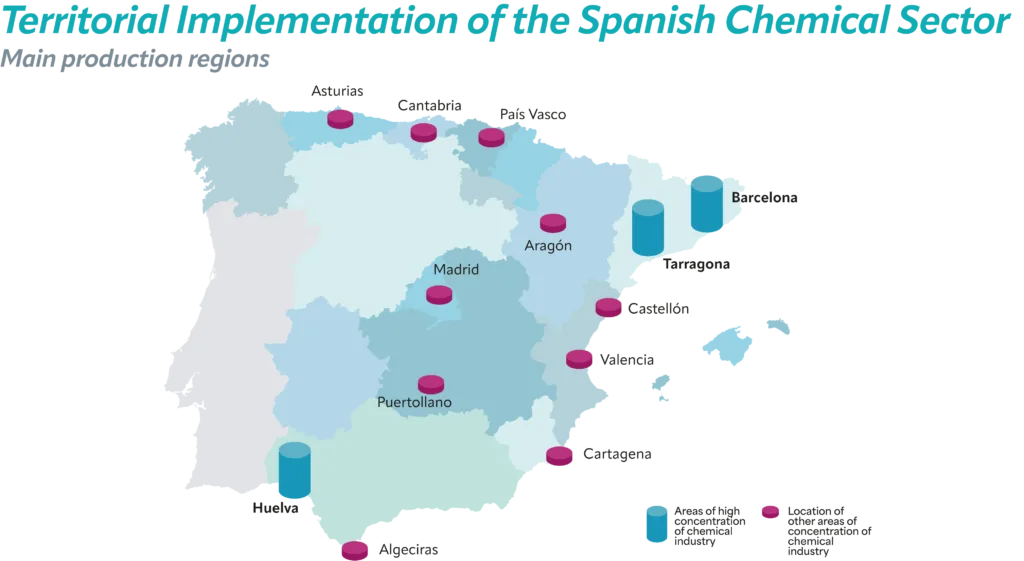
Madrid region accounts for 11.2% of national chemical output, mainly in pharmaceuticals and detergents.
Andalusia in southern Spain, accounts for 9.7% of national chemical output and is home to the country’s second-largest site, located in Huelva. Its main production areas are organic and inorganic chemicals, and the site directly and indirectly employs more than 19,000 people.
The Valencia region accounts for 9.4% of Spanish production.
Together these regions produce 74.2% of Spain’s chemicals
How are we doing?
Strengths
- Strong economic performance: Spain shows the highest cumulative GDP growth among major EU economies over 2019-2025 (+11.8%).
- Strong renewable energy potential: highly competitive solar and wind resources.
- Global export platform and strategic gateway to the EU chemicals market: exports to more than 200 countries and territories and competitive access to Europe, Africa, Latin America and increasingly Asia. Supported by Chemicals from Spain (ChemSpain)
- Growing domestic market: more than 48 million inhabitants, chemical consumption above €84 billion, over €1,700 per capita per year in chemical products, and more than €60 billion in chemical imports to meet domestic demand.
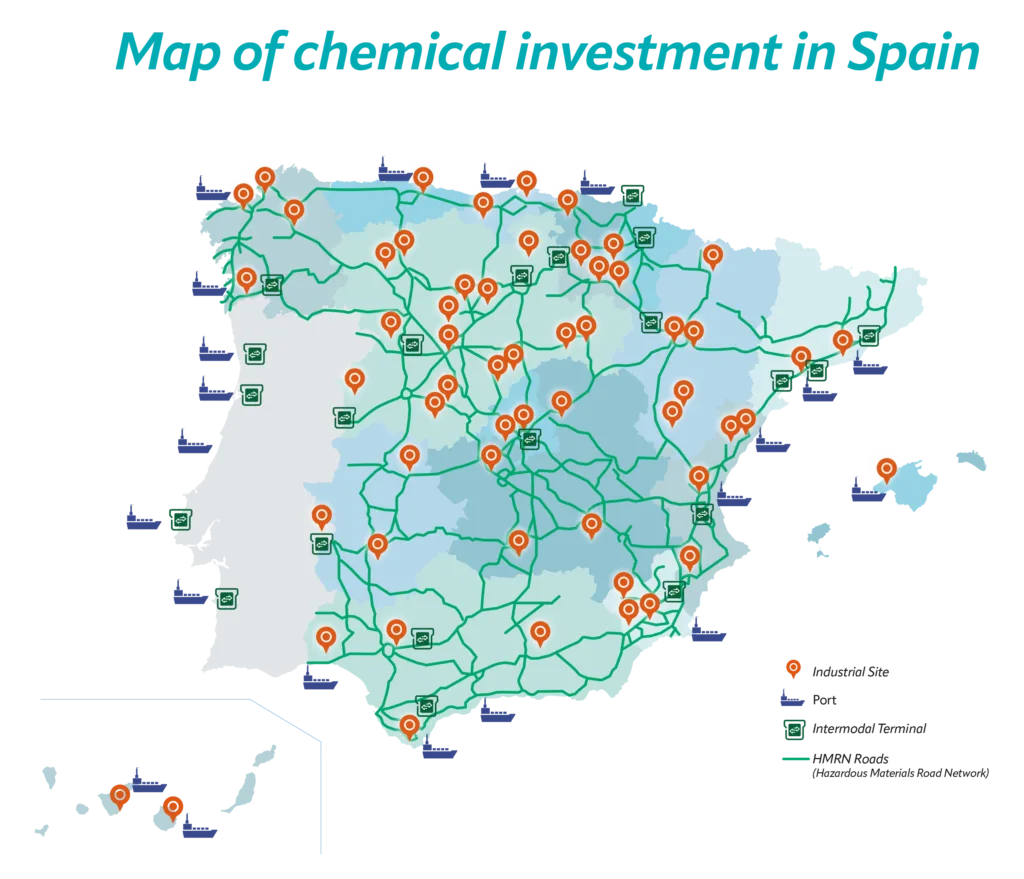
- Highly developed logistics infrastructure: one of Europe’s most extensive port networks, specialised chemical terminals and intermodal connectivity to Atlantic, Mediterranean and global trade routes.
- Competitive rail and road connectivity, integrated into the main TEN-T corridors and linking industrial hubs, strategic ports and international markets.
- Europe’s largest gas infrastructure: seven LNG regasification terminals, more than 11,000 km of gas pipelines and three underground storage sites.
- Competitive industrial locations, diversified sectoral ecosystems and advanced logistics and digital infrastructure.
- Highly skilled and cost-competitive talent.
- Spain’s most productive industrial sector: turnover above €377,000 per employee per year and the highest added value per employee.
- Strong innovation capacity: with 54.5% of chemical and pharmaceutical companies classified as innovative, supported by technology centres, public research entities and universities.
- Mature Industry 4.0 ecosystem: advanced automation, industrial robotics, IoT, data analytics, real-time control, digital twins and predictive maintenance.
- • Strong position in EU funding, with chemical, hydrogen and refining projects accounting for around one third of Innovation Fund support awarded to Spain.
- Strong alliance with key industrial sectors through the Alliance for the Competitiveness of Spanish Industry: shared agenda on competitiveness, energy, regulation and industrial policy.
Key challenge and priorities
- Ensuring access to secure and competitive energy, with competitive electricity, gas and CO₂ emission costs in Europe as the main condition to strengthen the competitiveness of basic chemicals and reduce the cost differential with the United States and China.
- Supporting industrial decarbonisation through effective investment instruments, including Carbon Contracts for Difference, to accelerate the deployment of low-carbon technologies.
- Ensuring a stable, predictable and efficient regulatory framework, with greater EU regulatory simplification and a more realistic adaptation of ETS and CBAM to industrial realities.
- Strengthening trade defence instruments against dumping, subsidies and global overcapacity, while ensuring access to strategic international markets.
- Protecting essential production and industrial sites for strategic autonomy.
- Addressing weak European demand, pressure on prices and growing international competition, while preserving the sector’s role as a key supplier to strategic industrial value chains.Strong economic performance: Spain shows the highest cumulative GDP growth among major EU economies over 2019-2025 (+11.8%).
Our contribution to a competitive Europe
Development of the Spanish strategy for industry and strategic autonomy
The Spanish Strategy for Industry and Strategic Autonomy sets out the general framework and key guidelines for Spain’s industrial policy, while complementing the industrial strategies promoted by the autonomous communities. Aligned with the European Union’s industrial policy and other relevant national strategies, it seeks to optimize resources and efforts to strengthen Spain’s industrial base, competitiveness, and strategic autonomy.
The Strategy addresses the key issues that will shape Spain’s industrial landscape in the coming years, including the role of industry in enhancing national competitiveness and strategic autonomy, the characteristics of the productive fabric and its value chains, and essential enabling conditions such as talent, innovation, digitalisation, and energy availability. It also identifies the priority challenges that should guide industrial policies towards 2030.
Feique actively contributes to the development of the Strategy through its participation in the consultation and policy-making process, ensuring that the priorities and needs of the chemical industry are reflected in Spain’s long-term industrial vision.
Developed in parallel with the parliamentary process of the Industry and Strategic Autonomy Act, the Strategy will serve as the main long-term framework for industrial policy and the achievement of the objectives established in the legislation. Its implementation will be supported by rolling three-year action plans setting out specific measures and programmes.
Development of the strategic reserve based on national industrial production capabilities (RECAPI) and participation in the Steering Board of the CCA
Spain is advancing the development of the Strategic Reserve based on National Industrial Production Capabilities (RECAPI), an initiative aimed at identifying and preserving industrial production capacities considered essential for the country’s security, resilience, and strategic autonomy. The mechanism seeks to ensure that critical industrial capabilities can be mobilised and maintained in response to supply disruptions, crises, or other strategic challenges.
As part of this initiative, the Ministry of Industry will work on the identification and mapping of industrial resources and production capabilities considered essential or strategic for the country. This exercise is expected to provide a clearer picture of Spain’s industrial strengths and vulnerabilities and support future policy measures aimed at strengthening industrial resilience.
The initiative is consistent with broader European efforts to reinforce strategic value chains and reduce critical dependencies. In this context, Spain also contributes to discussions on safeguarding key industrial ecosystems through its participation in the Steering Board of the Critical Chemicals Alliance.
Development of the High-Level Forum for Spanish Industry
The Ministry of Industry and Tourism has established the “High-Level Forum for Spanish Industry” to strengthen strategic dialogue mechanisms between the Administration and Spain’s main industrial sectors. The High-Level Forum is designed as the Government’s main advisory and dialogue body on industrial policy, with the aim of supporting public policies that enhance the competitiveness, sustainability and strategic autonomy of Spanish industry. The creation of the High-Level Forum for Spanish Industry is part of Spain’s renewed industrial policy framework, linked to the draft Law on Industry and Strategic Autonomy and to the development of the future Spanish Industrial Strategy.
Feique is a full member of the Forum, consolidating the representation of the Spanish chemical industry in one of the country’s key industrial dialogue platforms.
Through this initiative, the Ministry aims to strengthen public-private cooperation at a crucial time for Europe’s industrial transformation, marked by major challenges such as the energy transition, global competitiveness and the development of strategic capabilities.
Contribution to a competitive and sustainable Europe
The Spanish chemical industry is the second-largest sector in terms of added value contribution to the Spanish economy, the country’s leading exporter, the largest investor in R&D&I, and generates more than one million direct, indirect and induced jobs. This contribution translates into real economic and social progress, while providing a solid foundation for the strategic autonomy of the wider productive economy.
The sector also has the capacity to develop products and technologies that support sustainability and the continuous improvement of quality of life. This is reflected in its own transformation: between 2005 and 2024, process greenhouse gas emissions in the Spanish chemical industry fell by 49.3%, while energy consumption decreased by 26%. By combining industrial strength, technological capacity and environmental progress, the sector contributes to Europe’s climate neutrality objectives while helping to preserve the competitiveness and resilience of its industrial fabric.

