




Chemical industry snapshot
Updated with 2025 data
Basic macro-data on Slovakia
- Population: 5.43 million
- Area: 49 thousand km2
- GDP: USD 25 060 per capita in 2025
- Currency: euro (€) as of January 1, 2009
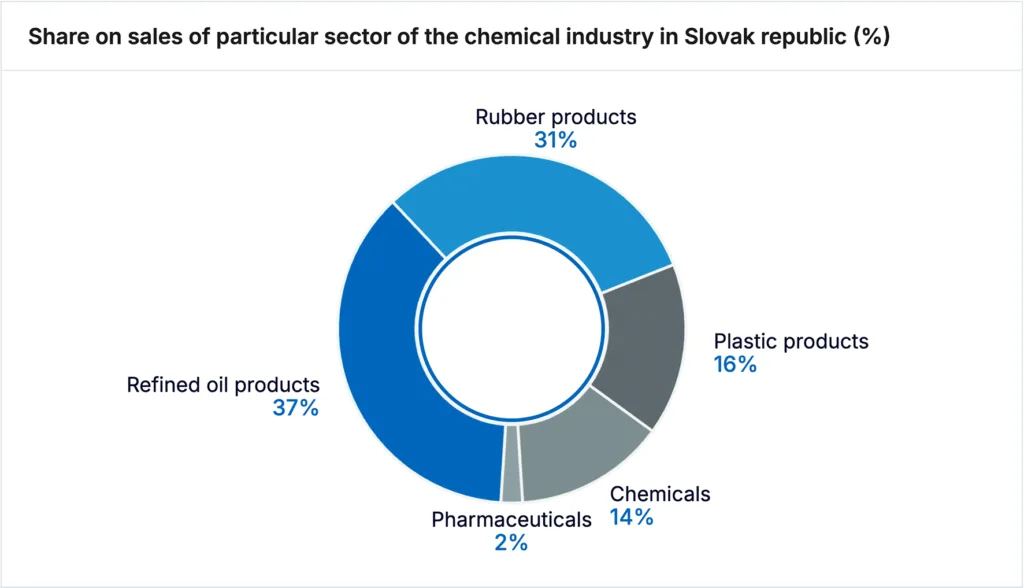
The chemical industry has traditionally been one of the key sectors of the Slovak economy. Two fo the strongest economic sectors – the automotive and the electronics industries – build a lot of opportunities for the suppliers of plastic components and rubber components (tyres). The chemical sector (including pharmaceuticals, rubber and plastics) is ranked third in terms of Slovakia industrial production.
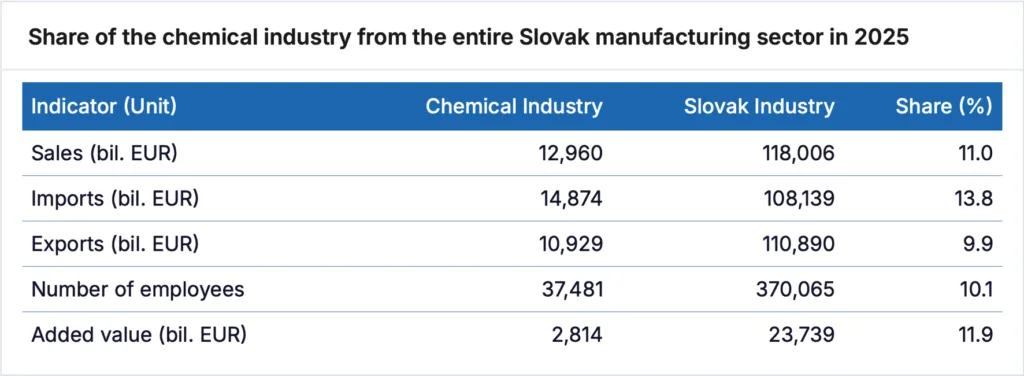
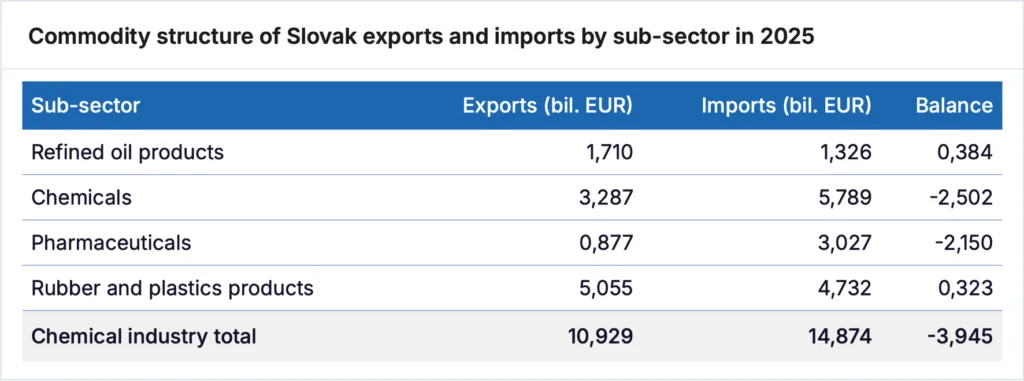
Data for 2025 show that revenues generated by companies in the chemical and pharmaceutical sector amounted to €12, 960 billion. The sector accounted for 11% of Slovakia’s total industrial production, which reached € 118 006 million. Exports and imports of chemical and pharmaceutical products increased year-on-year in 2025. The chemical sector contributed approximately 11.8% to Slovakia’s total gross value added.
At the end of 2025, the sector employed 37,481 people in 255 companies with more than 20 employees. Of these, 42.4% were employed in small companies, 46.3% in medium-sized companies and 11.4% in large companies with 250 or more employees.
The chemical and pharmaceutical industry represented 9.9% of Slovakia’s total exports and 13.9% of total imports.
Foreign Trade
Situational analysis
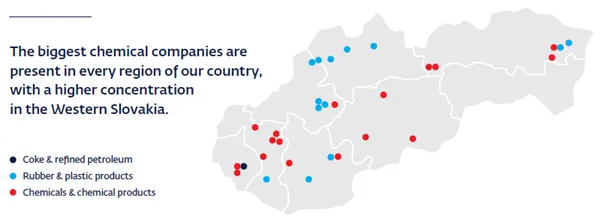
The largest chemical companies are present across all regions of Slovakia, with a higher concentration in Western Slovakia due to its well-developed infrastructure, transport networks and proximity to key export markets.
The Slovak chemical industry is highly diversified and encompasses a broad portfolio of products, including petrochemicals, agrochemicals, basic organic and inorganic chemicals, pharmaceuticals, rubber products (including tyres), plastics and specialty chemical products. Chemical production is concentrated mainly in Western Slovakia, where key facilities are engaged in oil refining, the production of primary plastics, rubber products, fertilisers, coatings, pharmaceuticals and plastic products. Central and Eastern Slovakia are characterised by the production of man-made fibres, plastic films and other chemical products.
In addition, a large number of small and medium-sized enterprises supply rubber, plastics and other components to the automotive industry. Slovakia is home to four major automotive manufacturing plants: Volkswagen Slovakia, Stellantis Slovakia, Kia Slovakia and Jaguar Land Rover Slovakia.A total of more than 1.07 million vehicles were manufactured in Slovakia in 2025, equivalent to approximately 196 vehicles per 1,000 inhabitants, the highest number per capita in the world.
With regard to higher education and research infrastructure, three universities are particularly important for the chemical and pharmaceutical industry: Comenius University in Bratislava, the Slovak University of Technology in Bratislava, and the Technical University of Košice.
In addition, several private R&D institutes operate in areas such as chemical technology, petrochemicals, plastics and man-made fibres. There is strong cooperation between specialised university faculties, research institutes and the Slovak Academy of Sciences.
Slovakia spends approximately 1.0% of its GDP on research and development (R&D), which remains below the EU average. The lack of public support for applied research and innovation continues to be a significant challenge for the Slovak chemical industry. In 2024, total expenditure on R&D in Slovakia amounted to €1.28 billion, of which €0.49 billion came from public sources and €0.79 billion from the private sector. Overall R&D expenditure represented 0.98% of Slovakia’s GDP.
How are we doing?
Strengths
- Strategic location in the heart of Europe, providing excellent access to North–South and East–West transport and trade corridors.
- Membership of the Eurozone and use of the euro currency.
- Stable and resilient banking sector.
- Well-educated, skilled and productive workforce.
- Long tradition of chemical and pharmaceutical production across all regions of Slovakia.
- Strong cooperation between industry, universities and research institutions.
- Research and development capacities ready to participate in international innovation projects.
- Expanding dual education system involving both domestic and international companies.
- Renowned university faculties educating highly qualified chemists, pharmacists, chemical engineers, pharmaceutical technologists and biotechnologists.
- High-quality scientific and research institutions with internationally recognised experts.
Challenges
- Limited domestic availability of raw materials required for chemical production.
- Relatively high electricity and natural gas prices compared to competing regions.
- Insufficient public support for applied research, development and innovation.
- Negative public perception of chemical production and industrial facilities.
- Demographic changes and an ageing population, leading to increasing labour shortages and generational workforce replacement.
- The need to accelerate infrastructure development and improve the business environment.
Our contribution to a competitive Europe
The Slovak chemical and pharmaceutical industry benefits from strong cooperation between universities, the Slovak Academy of Sciences, private R&D institutes and industrial research centres. Slovakia is recognised as one of the most productive manufacturing economies in Europe. Combined with a highly skilled workforce and competitive labour costs, this provides an attractive environment for investment and innovation.
The Association of Chemical and Pharmaceutical Industry of the Slovak Republic (ZCHFP SR) has been involved in several European cooperation projects and initiatives, including Nanoforce, FreeFOAM, INNOCHEM, ChemPharmVET, ChemMultimodal and ChemTube. These projects contributed to innovation, skills development and enhanced cross-border cooperation across Europe.

