




Chemical industry snapshot
Updated with 2025 data
An important industry providing high qualified jobs
With a turnover of more than 60 billion Euros (excluding pharmaceuticals) generated by more than 2,800 companies, Italy is the third European chemical producer. Virtue of its pivotal role in the national economy, the chemical industry delivers value that far exceeds its immediate footprint. Through the multiplier effect, every initial investment translates into a value added 3.32 times greater. About 113,600 highly qualified employees work in the sector and an even greater number of indirect jobs, more than twice as much as through direct employment, is activated in the economic system leading to an overall count of more than 327 thousand jobs connected to the chemical industry.
As a technology-intensive sector, the chemical industry will increasingly require young professionals possessing a robust educational background and specialized expertise, particularly within scientific disciplines. Currently, individuals under the age of 35 account for 22% of the industry’s workforce. Since 2015, employment within this demographic has expanded by 22%, significantly outpacing the more modest growth observed in the broader manufacturing sector (+11%). Furthermore, the hourly compensation for young employees in the chemical industry is 18% higher than the national average.
Strong and growing specialization in downstream chemicals
Italy maintains a significant and strategic presence in basic chemicals, but it is relatively more specialized in specialties and consumer chemicals, accounting for slightly more than 55% of total production value, compared to 37% of European average and realizing an export surplus of €6.9 billion in 2025. In downstream chemicals scale economies are not so relevant; the key to success is rather the ability to provide customers with high-performance and tailor-made products such as auxiliaries and additives for industry, paints and adhesives, cosmetics and detergents. Italy is also leader in the fields of active pharmaceutical ingredients, with export quotas exceeding 85% of production, and in bio-based chemicals.
A science-based industry operating in partnership with Italian Districts
The Italian chemical industry supports the sustainability and competitiveness of virtually all other industrial sectors through its innovative products and solutions. Being a country with a strong and diversified industrial basis, Italy represents the second largest market for chemicals in Europe accounting for more than €73 billion. In particular, there are about 150 Industrial Districts – including so-called traditional sectors but also medium-high technology ones – which are known around the world for their high quality and innovative products: their success very often relies on sophisticated chemical intermediates made in Italy and responding to specific requirements.
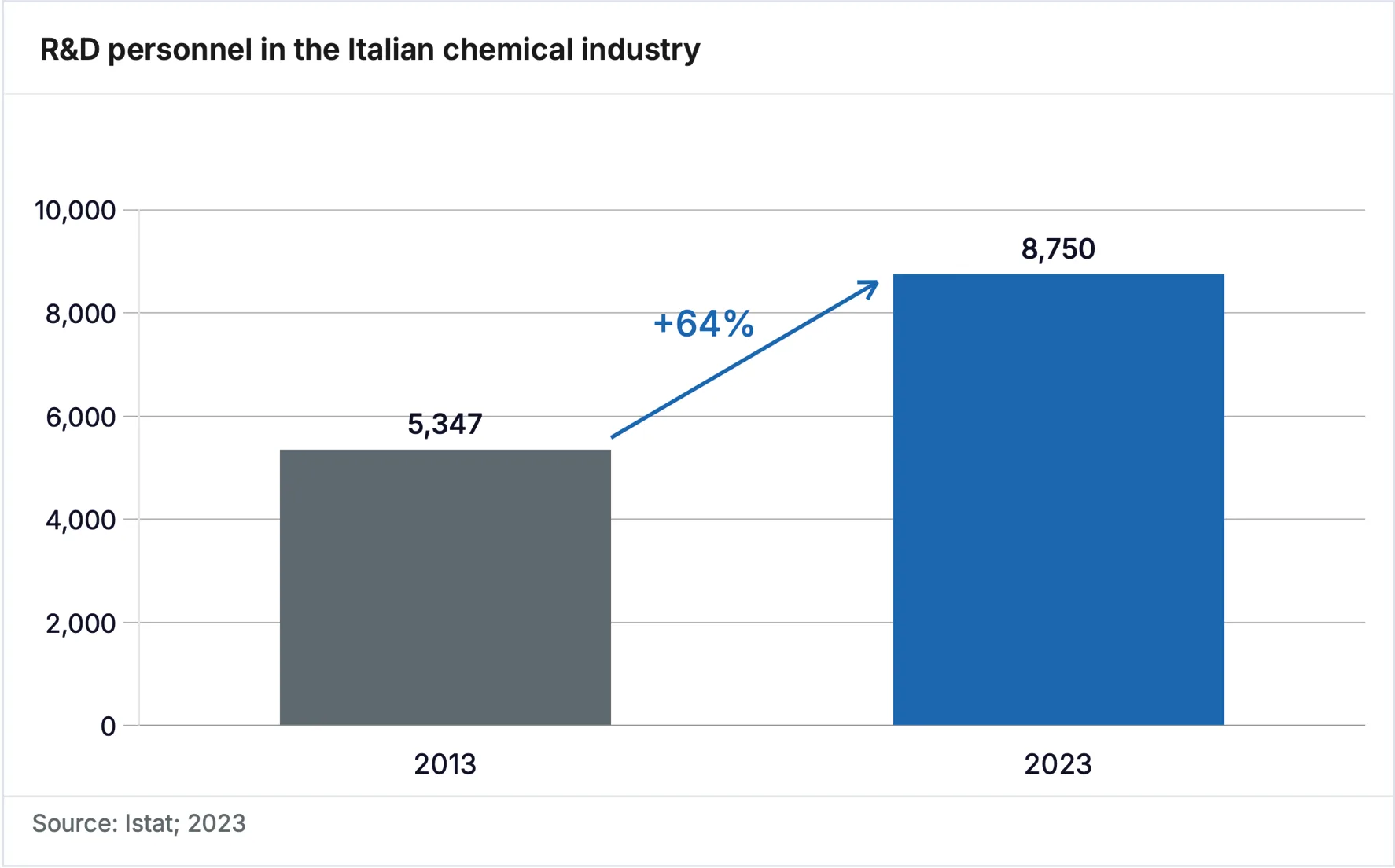
Chemical companies have been strengthening significantly their commitment to research in Italy: R&D personnel has increased by 64% over the last decade 2013-2023 and exceeds 8.750 employees. In particular, product innovation plays a crucial role within this sector, engaging approximately 60% of enterprises, compared to a manufacturing industry average of 39%. Consequently, the intermediate goods supplied by the chemical industry act as a vehicle for innovation, effectively transferring research-driven technological advancements throughout the entire supply chain to downstream sectors. R&D is fundamental also to pursue sustainability and circular economy. According to the Greenitaly report, in the period 2019-2023, 67% of chemical companies invested in environmentally friendly technologies and products, making the chemical industry the manufacturing sector that has invested the most in environmentally friendly solutions.
A well-balanced industry structure
The chemical industry in Italy is characterized by the well-balanced presence of three different actors, all of them playing a very important role: Italian SMEs (40% of total chemical production value), medium-large Italian groups (23%) and foreign-owned capital companies (37%).
Main Italian chemical groups include some big players of basic chemicals but also several dynamic specialized players leading in their specific niche at European or world level. Most of them also have production units in foreign markets. Foreign capital companies have chosen Italian location not only to produce for domestic market, but also to export and for R&D: activities conducted in Italy account for annual R&D investments exceeding 200 million euros. This commitment is underpinned by the presence of multiple centers of excellence nationwide, which hold global responsibility for the entire Group within specific chemical domains and production areas.
A high international attitude
Italian chemical companies are taking advantage of globalization by providing their international customers solutions according to the features developed for the domestic market: i.e. high-quality standards and innovation, customization, flexibility and just-in-time supply, even in small quantities of products.
The chemical industry in Italy is highly integrated into global markets: approximately 57% of production value refers to multinational companies, either domestic or foreign owned. Exports to turnover ratio has reached 62% and has been increasing by 26 percentage points in the last 20 years. Moreover, in recent years, export performance has proved to be one of the most successful among main European producers (+90% in 2010-2024, only behind Spain).
Not only large firms, but also SMEs are strongly oriented to international markets.
Lombardy: a real vocation for chemicals
Italian chemical industry is concentrated in Northern Italy (77,6% of chemical employment), close to downstream European markets and local customer companies. In particular, Lombardy has a real vocation for chemicals: not only it represents almost 41% of Italian chemical employees, but it is among the top five chemical regions in Europe. Considering fine and specialty chemicals, Lombardy ranks even higher, third among European regions.
Chemical industry in Lombardy has different features from other European regions with strong chemicals presence: production is not concentrated in a handful of highly integrated sites, but widespread across a network of foreign multinationals, Italian medium and large groups and local SMEs. These companies can benefit from the presence of major universities and research centres, able to develop industry-oriented projects.
How are we doing?
Strengths
- Strong interaction with industrial districts, i.e. SMEs belonging to the traditional and medium-high tech sectors of Made in Italy which are world trend setters, strongly oriented to innovation and always ready to test and develop new products.
- Talents: large pool of high quality and motivated Italian chemists with particular skills in areas including catalysts, fluorine chemicals, woven and non-woven polyester, polyurethanes, special polymers, leather chemicals, adhesives, pharmaceuticals active ingredients and cleaning additives.
- Widespread research-based innovation: in Europe Italy is second only to Germany for the number of chemical companies engaged in R&D, with more than 1,000 companies (both national and foreign-owned). In the chemical industry R&D personnel represents almost 8% of total employment compared to 5% in manufacturing average.
- Constructive industrial relations: Italy’s chemical sector has a participatory and pragmatic industrial relations culture that supports innovation and often anticipates changes in regulation. The National Collective Labour Contract aims at improving productivity also through organizational and working hours flexibility. It favours company-level bargaining and enables temporary agreements amending national rules. It also favours employability, training and youth employment. The chemical and pharmaceutical industry has been the first sector in Italy to adopt supplementary pension and healthcare funds.
- Remarkable results in terms of environmental protection: all kind of emissions have experienced impressive reductions, in particular the chemical sector has reduced its direct GHG emissions (scope 1) by 70%, exceeding the ambitious target set by the New Green Deal for 2030 (-55% compared to 1990).
- Safety: long experience and significant investments to promote safety for both employees (in the period 2022-2024, the chemical industry recorded one of the lowest amounts of occupational accidents per million hours worked among manufacturing sectors) and users.
Challenges
- High sensitivity to energy cost gaps compared to competitors.
- Logistics costs higher than in some other European countries.
- Lack of industrial culture and of confidence in new technologies in some parts of Society and Institutions.
- Possible vulnerability to external shocks (rising protectionism and global tensions) in the procurement of raw materials.
- Lengthy approval procedures with legal uncertainties representing an obstacle to the rapid development, adoption and dissemination of enabling technology solutions to promote circularity and sustainability throughout the economic system.
- Substantial investments are required to achieve the ecological transition. It is estimated that the green transition of the chemical industry in Italy will necessitate nearly 20 billion euros in additional capital expenditures by 2050 (representing a 40% increase relative to the annual average recorded during the 2016–2020 period). Furthermore, when incorporating projected operating expenses, the cumulative total is expected to exceed 30 billion euros.
Our contribution to a competitive Europe
Italy has developed an industrial policy framework supporting the competitiveness of its manufacturing base and accompanying long-term investment in strategic sectors, including chemicals, advanced materials and sustainable industrial technologies.
A broad set of incentive schemes and mechanisms supporting industrial innovation have been further strengthened, promoting in particular energy transition, internationalisation and advanced manufacturing, in order to enhance the competitiveness of the Italian chemical industry and the overall Italian manufacturing base. These incentives could also strengthen the national exporting potentialities, positively impacting the chemical sector.
Financial resources assigned by the Recovery Plan to the Italian National Recovery and Resilience Plan (“PNRR”) have continued to sustain required investment needs expressed by Italian organizations. Although the peak implementation phase of the PNRR is progressively approaching completion, several investment measures financed through EU Recovery Plan resources will continue to generate effects over the next two years, particularly in relation to industrial upgrading, sustainability and technological innovation.
Italy’s industrial strategy is increasingly aligned with broader European priorities concerning decarbonisation, digital transformation, strategic supply-chain resilience and the transition towards a more circular and energy-efficient economy.
Particular attention continues to be dedicated to:
- sustainable manufacturing and industrial decarbonisation;
- energy efficiency and renewables’ generation;
- digitalisation and smart production systems;
- strategic industrial supply chains and clean technologies;
- export capacity and international competitiveness.
Additional opportunities are also available for investments located in Southern Italy through Special Economic Zones (“ZES Unica”), which combines fiscal incentives with simplified administrative procedures for strategic industrial projects.
Fostering environmental sustainability and digital transformation
Italy continues to support the transition towards sustainable and digitally integrated manufacturing through a combination of tax incentives, public co-financing schemes and innovation partnerships involving companies, universities and research centres.
The main industrial policy framework currently supporting this transition is the “Transition Plan 5.0”, aimed at encouraging companies to invest in advanced manufacturing technologies, industrial digitalisation and energy-efficiency improvements.
Companies investing in innovation projects, interconnected production systems, advanced machinery and renewables’ generation technologies may benefit from tax incentives linked to measurable reductions in energy consumption and improvements in production efficiency.
The overall policy approach increasingly links public support measures to sustainability objectives, favouring projects capable of contributing to:
- lower industrial emissions;
- reduced energy intensity;
- circular manufacturing models;
- process optimisation and automation;
- integration of renewable energy solutions.
Within the broader innovation ecosystem promoted under the PNRR framework, Italy has also strengthened collaboration platforms between public and private stakeholders aimed at accelerating industrial research and technology transfer activities.
Among these initiatives, the extended partnership Made in Italy Circular and Sustainable (“MICS”), involving universities, companies and research organisations, continues to support research and development (“R&D”) and innovation projects focused on circular economy solutions, sustainable materials, digital technologies and resource efficiency across several strategic Made in Italy sectors.
Financial support mechanisms promoting industrial energy efficiency also remain available through the White Certificates scheme, which incentivises certified projects capable of generating measurable reductions in energy consumption and CO₂ emissions.
Additional financial support for industrial companies is increasingly available through SIMEST, the Italian public company supporting internationalisation strategies. SIMEST currently promotes financing instruments dedicated to:
- export development;
- ESG and sustainability investments;
- energy-efficiency projects;
- participation in international markets;
- supply-chain strengthening and digital transition initiatives.
These measures are particularly relevant for export-oriented and energy-intensive manufacturing industries (in which are included chemical industries).
Encouraging innovation and collaborations between public and private sectors
Italy provides a broad range of fiscal incentives and financial instruments supporting industrial research, technological innovation and collaboration between companies, universities and research institutions.
Tax incentives supporting research and innovation activities remain one of the key pillars of the national industrial policy framework, with particular relevance for sectors characterised by high technological intensity such as chemicals, biotechnology, advanced materials and sustainable industrial processes.
Current incentive schemes support activities related to:
- industrial research and experimental development;
- technological innovation;
- digital transformation;
- ecological transition and sustainable process development;
- design and engineering activities connected with industrial innovation.
Italy also maintains a Patent Box regime aimed at encouraging the development and exploitation of intellectual property generated through R&D activities. The mechanism provides enhanced fiscal deductibility for eligible R&D expenditures connected with intangible assets.
Public support for industrial investments also continues through subsidised financing instruments such as “Nuova Sabatini”, which facilitates companies’ access to credit for the purchase or leasing of machinery, industrial equipment, production technologies and digital solutions.
For medium and large-scale industrial projects, additional support may be available through “Development Contracts”, dedicated to strategic investments involving manufacturing expansion, environmental upgrading, industrial innovation and sustainable transformation initiatives.
Italy also encourages collaboration between companies and the research system through programmes supporting industrial PhDs and technology-transfer partnerships involving universities and private companies. These initiatives aim to facilitate the recruitment of highly qualified researchers and strengthen the alignment between academic research and industrial innovation needs.
Training and workforce upskilling programmes focused on digital and technological competences remain available through inter-professional funds and dedicated industrial training initiatives supporting companies engaged in innovation and sustainability projects.
Finally, the Italian National Promotional Institution, Cassa Depositi e Prestiti (CDP), plays a strategic role in supporting industrial growth, sustainable investments and innovation projects through long-term financing instruments, co-investment platforms and dedicated funding schemes for manufacturing industries.

