




Chemical and pharmaceutical industry snapshot
Updated with 2025 data
Third-largest industry in Germany
With a turnover of €220.4 billion in 2025, the chemical and pharmaceutical industry is Germany’s third-largest industry after automotive and mechanical engineering. Within the European Union, Germany is by far the most important production centre for chemical and pharmaceutical products, accounting for 22% of the total production. Globally, the German chemical and pharmaceutical industry ranks third.
A diverse and high-performing industrial sector
The German chemical and pharmaceutical industry is diverse and highly efficient. Its strength lies in its high-performing companies and highly qualified workforce. A well-trained workforce is the cornerstone of the sector. They drive research and development forward, improve production processes and continuously develop new solutions.
In addition, there is a strong industrial base: world-leading corporations work closely with highly specialised small and medium-sized enterprises – the Mittelstand. This combination brings together economic strength with a high degree of flexibility and strengthens the entire value chain.
High environmental, safety and social standards, together with strict quality controls, ensure safe, reliable and high-quality products. This reinforces the excellent international reputation of German chemical and pharmaceutical products. The sector is also strongly export-oriented and closely integrated into international markets. This underlines the international competitiveness of the companies and their great importance to Germany as a business location.
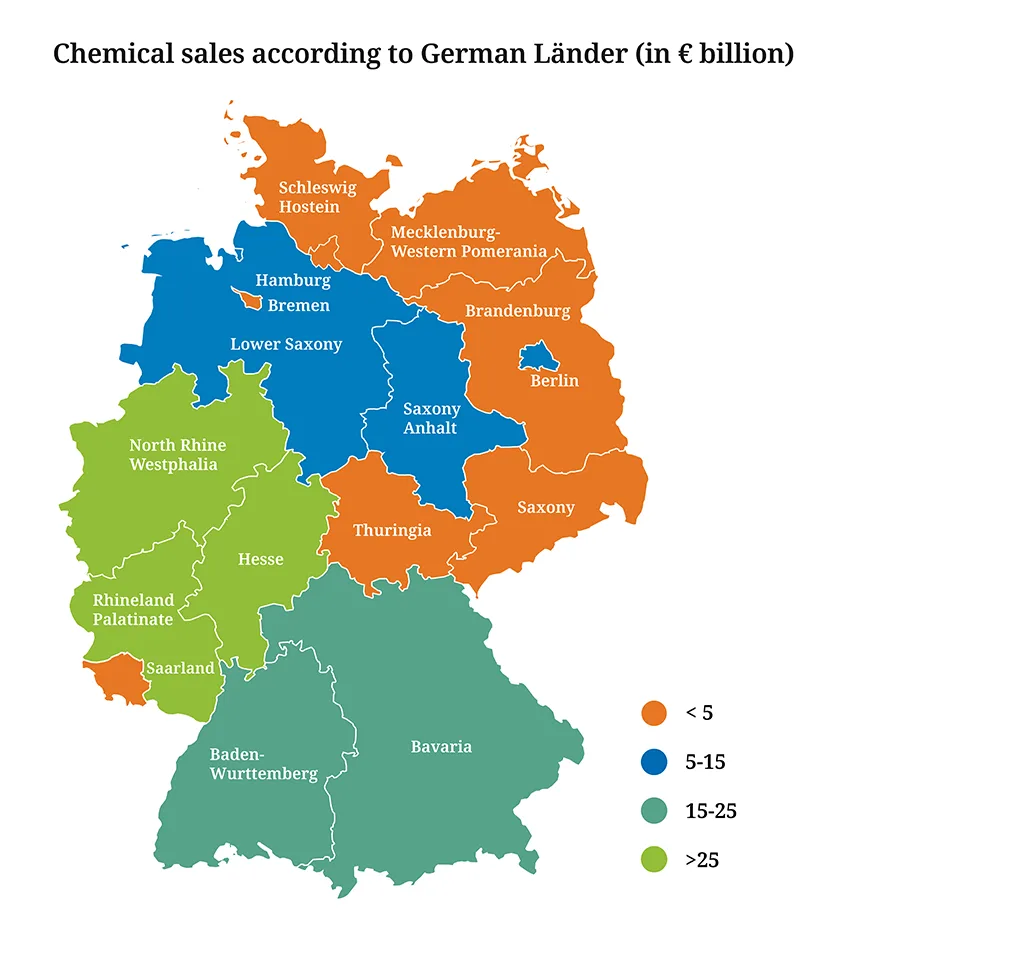
Another factor contributing to its success is the industry’s great diversity. It is represented in all key segments – from basic chemicals, petrochemicals and polymers, through crop protection products and speciality chemicals, to cosmetics and pharmaceuticals. Geographically, the industry is widely spread across Germany as well. Regional clusters have specialised in different areas from basic chemicals to high-value speciality chemicals and pharmaceuticals.
As a key industry for virtually all other industrial sectors, the chemical industry plays a central role in almost all economic regions and industrial clusters in Germany. Its strength is therefore evident not only in individual segments or at individual sites, but across the entire sector.
In 2025, the sector comprised more than 2,000 companies, many of which were located in around 60 chemical parks. Due to the pressures caused by the energy crisis and a weak industrial economy, the sector’s turnover fell to around €220 billion. However, the sector’s international focus remained strong: around 62% of total sales were generated abroad.
Overall, the German chemical and pharmaceutical industry is known for its innovative strength, high quality standards, structural diversity and international competitiveness. It therefore remains one of the world’s leading industrial sectors.
Transport infrastructure as a location factor
The three largest chemical industry clusters are situated along the Rhine: North Rhine-Westphalia, Rhineland-Palatinate and Hesse, with its strong pharmaceutical sector. An efficient transport infrastructure is a crucial location factor for the chemical and pharmaceutical industries. However, there is a considerable need for investment, particularly in waterways and railways. In Eastern Germany, Saxony-Anhalt is the most important chemical industry cluster.
Another location advantage is the well-developed logistics infrastructure. Efficient logistics, established chemical parks and reliable supply chains enable smooth and cost-effective production processes. This boosts productivity and international competitiveness.
Driving transformation through research and innovation
Around three-quarters of German chemical and pharmaceutical companies carry out their own research and development. Expenditure on this amounted to around €16.5 billion in 2025. Only around 2% of this expenditure is funded by the state. At the same time, industry, universities and research institutions work closely together.
Research and innovation are among the sector’s greatest strengths and are key drivers of its transformation. Germany is a world leader in this field. Close collaboration between businesses, universities and research institutes ensures that scientific findings are rapidly translated into marketable products and processes.
The German chemical and pharmaceutical industry also plays a leading role in the dual transformation towards digitalisation and sustainability. Companies are increasingly turning to modern digital technologies such as artificial intelligence, data analytics and automation to optimise production processes, boost efficiency and drive innovation.
At the same time, the industry is investing heavily in sustainable production processes, climate-neutral technologies, solutions for the circular economy and the development of environmentally friendly products.
Combining digitalisation and sustainability enables the sector to improve its environmental performance whilst at the same time strengthening its competitiveness in an increasingly demanding global market. As a result, the German chemical and pharmaceutical industry is regarded internationally as a pioneer of sustainable and digitalised industrial development.
How are we doing?
The German chemicals industry is slowly recovering from an exceptionally difficult period characterised by far-reaching geopolitical changes. At the same time, ongoing geopolitical tensions are continuing to put pressure on established supply chains. Intensified international competition, particularly from China, is increasing the pressure on companies to adapt. The high volume of imports of low-cost chemical products has significantly intensified competitive pressure in Europe and triggered trade defence measures. Since the start of 2023, chemical production has stagnated at around 80% of the 2021 production level.
At the same time, the consequences of the prolonged crisis of recent years are still being felt. Russia’s war of aggression against Ukraine and the associated energy shock have led to persistently high energy costs. The conflict in the Persian Gulf is causing further uncertainty in energy markets and putting pressure on global supply chains. In many sectors, companies have been unable to fully offset the increased costs through higher selling prices. The result is falling margins and declining profitability.
The outlook for 2026 also remains subdued. High energy prices, persistent inflationary pressures and increasing pressure from imports are weighing on the German economy and, to some extent, the European economy as well. Despite high production capacities worldwide, demand for chemical products remains weak. Consequently, no significant upturn in demand is expected in Germany in the short term.
Furthermore, there are structural disadvantages associated with the location: high taxes, levies and energy costs drive up production costs. Bureaucratic red tape, infrastructure in need of renewal, and protracted approval and planning procedures are holding back investment and innovation.
Key long-term developments include sustainability, climate protection, resource conservation and the circular economy. Working alongside its customers, the chemical and pharmaceutical industry is developing new processes and products with the aim of achieving greenhouse gas neutrality by 2050 at the latest, utilising CO2 as a feedstock, and using plastics as a starting material for new products through high-quality recycling.
At the same time, future technologies such as nanotechnology and biotechnology are unlocking new opportunities to make production processes more efficient and accelerate innovation. The hydrogen economy is also emerging as a key pillar of a climate-friendly energy supply and industrial transformation. Furthermore, digitalisation, through data-driven processes, improves the management of production and resource flows, thereby supporting the goal of an industry that is both sustainable and economically successful.
Strengths
- A strong and internationally competitive industrial ecosystem with highly integrated chemical clusters and chemical parks, close links with other industrial sectors, and deep integration into global value chains.
- The strong capacity for innovation of the chemical and pharmaceutical industry, underpinned by a robust research and development ecosystem and close collaboration between companies, universities and research institutions. This supports sustainable transformation and the development of new business models.
- A leading position in future-oriented technologies such as climate-friendly production processes, chemical recycling, digitalisation, and solutions for sustainability and the circular economy.
- A dynamic Mittelstand with numerous highly specialised ‘hidden champions’ and an excellent research environment. This combination fosters innovation, flexibility and high resource efficiency.
- Highly qualified skilled workers, supported by an effective education system offering dual training, close cooperation throughout the value chain, and the ability to reliably meet sophisticated customer requirements.
- A reliable framework comprising high-quality infrastructure in the heart of Europe, a well-established social partnership between businesses and trade unions, and access to public funding schemes.
- Many years of expertise in the fields of safety, environmental protection and health and safety, as well as an generally positive public perception as a major industrial employer.
- A well-established social partnership between trade unions and employers’ organisations, which promotes stability and predictability (Sozialpartnerschaft).
Challenges
- Structural competitive disadvantages arising from persistently high energy costs, uncertainties regarding future energy supply, the slow expansion of the electricity grids in the wake of the Energiewende (energy transition), and heavy reliance on imported raw materials.
- Growing geopolitical and trade-related risks. Protectionism, tariffs, regulatory uncertainties and tensions between major economic blocs are putting pressure on supply chains and making it more difficult to access international markets.
- Global shifts in investment, particularly towards China, are increasing price pressure, reducing profit margins and leading to factory closures. At the same time, the incentives for investment and innovation in Germany are diminishing.
- A high degree of dependence on the automotive industry, which means that economic fluctuations and crises in other sectors have a particularly severe impact on the chemical industry.
- Skills and qualifications shortages resulting from demographic change, as well as a growing shortage of skilled workers, particularly in the field of digitalisation. This limits future growth potential.
- Shortcomings in infrastructure and regulation, slow progress in digitalisation, protracted approval procedures, and legal uncertainties at national and EU level. These factors are holding back investment and transformation.
- Need for improvements to financing conditions so that innovation and industrial transformation can be better supported in future.
Our contribution to a competitive Europe
Creating a framework for success
The new Federal Government has declared the chemical and pharmaceutical industry to be a key focus of its industrial policy. The 2025 coalition agreement explicitly identifies the sector as a leading industry, whose competitiveness is crucial to innovation, economic growth and Germany’s resilience.
Strategic importance in a changing geopolitical landscape
The chemical and pharmaceutical sectors are among Europe’s key industrial sectors. They supply essential intermediate products for virtually all value chains – from healthcare and agriculture, through energy and mobility, to the security and defence industries.
The experiences of recent years, from supply chain disruptions to the pandemic, have highlighted just how vulnerable Europe becomes when the production of critical goods takes place outside Europe.
Against this backdrop, the German government is pursuing the aim of developing Germany into the world’s most innovative hub for the chemical, pharmaceutical and biotechnology sectors. The aim is to strengthen Europe’s technological autonomy and resilience. This particularly applies to critical raw materials, active pharmaceutical ingredients, and key technologies.
Maintaining and repatriating strategically important production capacity to Europe is therefore of great significance not only in terms of economic policy but also in terms of security policy. This is especially true in light of growing geopolitical tensions, an uncertain energy supply and intensified global competition for technologies and resources.
Key areas for policy action
- Reducing energy costs and securing supply
High energy costs remain one of the sector’s biggest competitive disadvantages. The German government has therefore introduced an industrial electricity tariff for energy-intensive companies for the years 2026 to 2028.
The measure is temporary and does not provide equal relief to all businesses. However, it helps to reduce structural cost disadvantages and prevent production from being relocated abroad. - The Chemieagenda 2045
One of the key industrial policy initiatives is the Chemieagenda 2045, developed in collaboration with industry, trade unions and the Länder. It sets out in detail the measures envisaged in the coalition agreement and includes, among other things:
• Reducing electricity costs,
• Further developing European instruments such as the Emissions Trading Scheme (ETS) and the Carbon Border Adjustment Mechanism (CBAM),
• Simplifying European chemicals legislation (REACH),
• Cutting bureaucracy and speeding up approval and planning procedures.
The agenda is intended to provide immediate relief whilst also offering a long-term framework for the transition to a climate-neutral and internationally competitive chemical industry. - Boosting innovation and improving market access
Innovation is at the heart of the industrial policy strategy. Particularly, this includes:
• the further development of the pharmaceutical strategy and industry dialogue,
• the targeted promotion of biotechnology as a key technology,
• an improved regulatory framework and faster market access for innovative therapies.
The aim is to further strengthen Germany’s position not only as a leading centre for research, but also as an attractive location for manufacturing and innovation.
- Reduce bureaucracy and facilitate investment
There is widespread consensus that complex administrative procedures and lengthy approval processes hinder investment. The Federal Government therefore intends to simplify regulation and significantly speed up planning and approval procedures. This is a key prerequisite for implementing major industrial investments more quickly and strengthening the country’s competitiveness in the long term.
The role of defence spending and investment in infrastructure
In addition to sector-specific measures, the competitive position of the chemical and pharmaceutical industry is also shaped by the broader framework of financial and industrial policy.
Defence spending as a stimulus for the industry
Rising spending on defence, driven by the changing security landscape, is also having a positive impact on the chemical and pharmaceutical industry. Numerous speciality chemicals, high-performance materials and pharmaceutical products are indispensable components of modern defence systems. These applications are particularly evident in protective equipment, advanced materials, and medical supplies.
Higher defence budgets can boost demand for high-quality industrial inputs, strengthen domestic value chains and encourage investment in future technologies, which can often be used for both civilian and military purposes.
Infrastructure investment via special funds
The financing of infrastructure and transformation projects through special funds (Sondervermögen) also helps to improve the operating environment for industry. The funds are intended to help:
• to modernise energy and transport infrastructure,
• to accelerate the expansion of renewable energy, and
• to strengthen resilience and digital infrastructure.
These investments are of crucial importance to the chemical and pharmaceutical industry. High-performance energy networks, a hydrogen infrastructure, CO₂ transport and storage systems, and efficient logistics are essential prerequisites for transformation and growth.
In the short term, however, the impact of these measures is likely to remain limited. The funding is often tied to complex procedures and lengthy planning periods. In the long term, they offer significant opportunities to strengthen Germany’s industrial base.
Outlook – There remains a significant need for action
The direction of industrial policy is clear: Germany is working to stabilise and strengthen one of its most important industrial sectors in the long term. The Federal Government has launched key initiatives, introduced targeted support measures and emphasised the strategic importance of the chemical and pharmaceutical industry.
At the same time, there remains a great need for action. From the perspective of the chemical and pharmaceutical industry, this is not merely a temporary economic downturn, but a structural challenge to the competitiveness of the business location.
Structural competitive pressure remains high
The biggest challenge remains the persistently high energy costs. These are structurally well above the levels seen in key competitor countries such as the US or many Asian nations. The industrial electricity price is an important step, but it is temporary and only provides partial relief for businesses.
Added to this is a persistent regulatory burden, arising both from European frameworks such as the ETS, CBAM and REACH, and from national regulations. Even where reforms have been announced, the implementation and decision-making processes are often protracted and the outcome uncertain. For a capital-intensive industry with long-term investment cycles, this means a lack of planning and investment certainty.
The gap between strategy and reality
A key challenge lies in the discrepancy between political announcements and their practical implementation. Whilst initiatives such as the Chemieagenda 2045 or the Pharma- und MedTech-Dialog demonstrate the political will to support the sector, many measures are still at an early stage of implementation.
Furthermore, there are conflicting objectives within the policy framework. On the one hand, the aim is to strengthen the pharmaceutical industry in a targeted manner. On the other hand, cost-containment measures in the healthcare sector, such as changes to pricing, may reduce companies’ revenues and weaken incentives for investment. Such conflicting objectives diminish the effectiveness of the overall policy framework.
International competition is intensifying
International developments are also increasing the pressure to act. The US is creating attractive investment conditions through extensive support programmes such as the Inflation Reduction Act. China is relying on targeted support measures that are implemented relatively quickly, too.
Germany and the European Union, by contrast, are often regarded as slower and more complex – particularly when it comes to approval processes and funding schemes. This increases the risk that investment in future technologies such as hydrogen, electrification and biotechnology will increasingly take place outside Europe.
Infrastructure as the key to transformation
The additional investment in infrastructure sends an important signal. Nevertheless, key prerequisites for a successful transformation are still lacking to a sufficient extent. These include, in particular:
• affordable renewable energy,
• high-performance electricity grids,
• a nationwide hydrogen infrastructure, and
• CO₂ transport and storage systems.
Only if rapid progress is made in these areas can the transition to climate neutrality be achieved successfully from an economic perspective.
Overall assessment: On the right track, but further action is needed
Germany has made a noticeable shift in its industrial policy and has clearly recognised the strategic importance of the chemical and pharmaceutical industry. The policy framework is increasingly moving in a direction that is conducive to industry and innovation, and key instruments are being introduced gradually.
Nevertheless, the measures taken so far are not yet sufficient to fully offset the location’s structural competitive disadvantages. The implementation of policy initiatives remains a key challenge.
There is therefore still a great need for action. If Germany is to maintain its position as a leading centre of industry and innovation, the following steps in particular are required:
- implement policy measures much more quickly,
- provide businesses with lasting and tangible cost relief,
- consistently reduce regulatory complexity, and
- better coordinate industrial, energy and health policies.
Conclusion
Germany has embarked on a new course in industrial policy. The importance of the chemical and pharmaceutical industry is now recognised much more widely than it was just a few years ago, and significant reforms have been set in motion.
At the same time, the sector continues to face significant challenges. Many measures are still in the implementation phase; progress is, in some cases, only being made gradually; and key locational disadvantages – in particular, high energy costs and a heavy regulatory burden persist.
We are heading in the right direction. The key now will be to implement the measures that have been introduced swiftly, consistently and reliably. If we succeed in doing so, they can lay the foundations for Germany and Europe to continue to have a competitive, innovative and resilient chemical and pharmaceutical industry in the future.

