




Chemical industry snapshot
Updated with 2025 data
According to Statistics Estonia, 161 companies operated in the manufacture of chemicals and chemical products (NACE C20) in 2024, employing an average of 2,196 people.
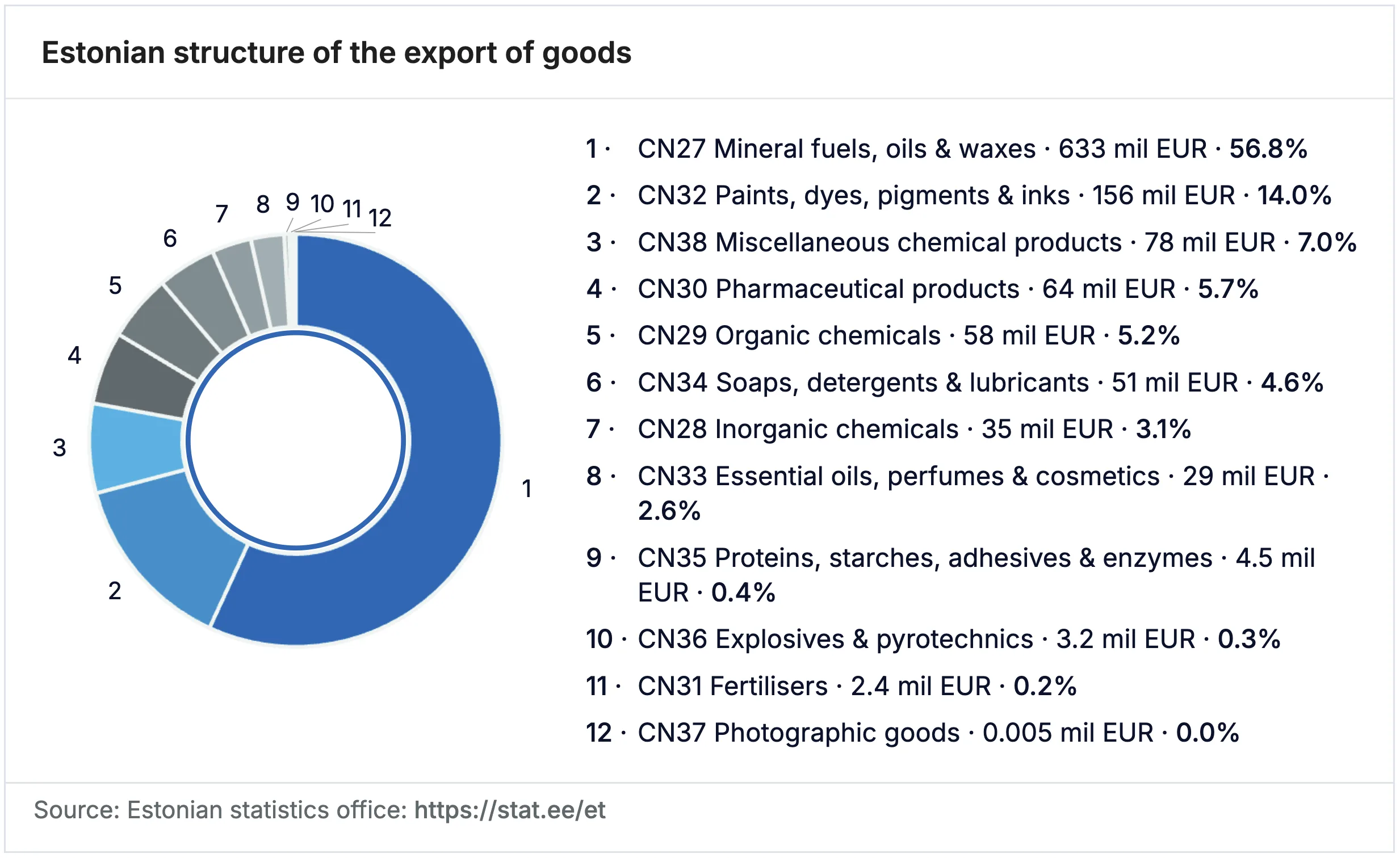
The sector generated a turnover of €509.5 million, of which €383.5 million (75.3%) came from exports, demonstrating its strong international orientation. Although the chemical industry represents only around 1.7% of manufacturing companies and 2.1% of manufacturing employment, it accounts for approximately 3% of Estonia’s manufacturing exports.
Like many European chemical industries, the Estonian sector has faced a challenging economic environment in recent years. Between 2022 and 2024, turnover and exports declined by around 30%, reflecting weak industrial demand, high energy and raw material costs, and reduced competitiveness across European manufacturing.
Despite these challenges, the industry continues to invest in innovation, sustainability and compliance with evolving EU legislation while remaining an important contributor to Estonia’s industrial value chains and export economy.
The official statistics (NACE C20) do not fully reflect the structure of the Estonian chemical industry. Two highly specialised sectors represented by the Estonian Chemical Industry Association – shale oil and shale chemicals, and rare earth materials production – are classified under other NACE activities. Together, these sectors generate a turnover and employment comparable to the entire official chemical industry (NACE C20), making them an integral part of Estonia’s chemical value chain and industrial ecosystem.
Although the Estonian chemical industry is relatively small in size, it is highly diverse. The Estonian Chemical Industry Association (ECIA) therefore brings together companies from across the entire chemical value chain, including manufacturers of industrial chemicals and specialty chemicals, shale oil and shale chemicals, rare earth materials, paints, coatings and construction chemicals, detergents and cleaning products, cosmetics and personal care products, polyurethane foams and plastic products, chemical distributors, logistics providers and other service companies supporting the sector.
Situational analysis of the chemical industry
The Estonian chemical industry is characterised by a strong territorial concentration, with more than half of the sector’s industrial activity located in Ida-Viru County (East-Viru). This reflects the region’s long-standing industrial base, established infrastructure, availability of raw materials and specialised expertise.
Two distinctive features of the Estonian chemical industry are oil shale chemistry and the production of rare earth materials and compounds. Oil shale processing has a long industrial tradition in Estonia, with shale oil production dating back to 1924. Today, oil shale chemistry remains an important and highly specialised part of Estonia’s industrial base and is closely linked to the country’s energy, chemical and materials value chains.
Estonia’s chemical exports include a range of oil shale-derived products and specialty chemicals, as well as rare earth materials and compounds. The sector also includes producers of construction chemicals, including sealants and construction adhesives, which have an important role in Estonia’s chemical product exports. Other parts of the industry are more domestically oriented, but Estonia has established expertise in cosmetics, detergents and cleaning products, paints and coatings, and other formulated chemical products.
The Estonian chemical industry is relatively small in overall size but highly diverse and internationally connected. It includes activities ranging from basic and specialty chemicals and oil shale chemistry to advanced materials, formulated products, chemical distribution and related services. This diversity is also reflected in the membership of the Estonian Chemical Industry Association (ECIA), which brings together companies operating across different parts of the chemical value chain.
The Estonian chemical industry also maintains close links with research and higher education institutions. Estonian universities providing education and research in chemistry, chemical engineering and related fields contribute to the sector’s skills base, technological development and innovation capacity.
How are we doing?
Strengths
- Strong export orientation and international market exposure, with Estonian chemical companies active in both European and global value chains.
- Highly diverse and flexible industry structure, ranging from basic and specialty chemicals to formulated products, advanced materials and chemical-related services.
- Specialised expertise in oil shale chemistry and processing, representing a distinctive industrial competence developed over more than a century.
- Specialised expertise in rare earth materials and compounds, an important and strategically relevant part of Estonia’s materials and chemical value chain.
- Competitive niche and specialty products, including construction chemicals, polyurethane products, cosmetics, detergents and other formulated chemical products.
- Skilled workforce and strong technical expertise, supported by Estonia’s universities and research institutions.
- Established industrial infrastructure and know-how, particularly in Ida-Viru County, providing a basis for further development and diversification of the chemical and materials industries.
Challenges
- High energy and other input costs continue to undermine the competitiveness of energy-intensive and internationally exposed chemical production in Europe.
- Growing regulatory and administrative burden, particularly for SMEs, creates increasing compliance costs and requires substantial technical and regulatory expertise.
- Limited availability and fragmentation of support for industrial R&D and innovation, particularly for SMEs and companies operating in technology- and research-intensive segments.
- Increasing competition from regions with lower energy, regulatory and production costs, putting pressure on the competitiveness and investment attractiveness of European industry.
- The transition towards a low-carbon and circular economy presents particularly significant challenges for resource- and energy-intensive activities, including oil shale-based chemical production. At the same time, the transition requires realistic technological and economic pathways that take into account the availability of alternative technologies, infrastructure and investment.
- Access to skilled labour and specialised expertise is becoming increasingly important as regulatory, technological and digital requirements across the industry grow.
The chemical industry is a suitable industry for Estonia because:
- The chemical industry generates relatively high economic value from a specialised workforce and supports a wide range of downstream industrial activities.
- Chemical production is an important part of Estonia’s industrial and export value chains, supplying inputs to construction, manufacturing, consumer products, energy and other sectors.
- A significant part of the sector is based on specialised knowledge, technology and established industrial infrastructure, making these activities less easily replaceable than simple production based solely on labour costs.
- Estonia has distinctive local industrial and natural-resource assets, including oil shale, which have supported the development of specialised chemical and materials expertise in Ida-Viru County.
- The chemical industry contributes to the economic diversification and development of Ida-Viru County, where maintaining and transforming industrial capabilities is particularly important.
- Chemical products and technologies are essential inputs for the green and digital transitions, including materials, energy technologies, construction, water treatment and other strategic value chains. Maintaining chemical production capacity in Europe is therefore also relevant to security of supply and industrial resilience.
- Estonia’s relatively small domestic market means that international competitiveness and access to export markets are essential for the continued development of the sector.
- The future competitiveness of the Estonian chemical industry will depend on creating conditions that allow companies to invest in innovation, decarbonisation and new technologies while maintaining internationally competitive operating costs.
- For oil shale-based chemical activities in particular, the transition needs to recognise the specific technological, economic and regional circumstances of the sector and provide a credible pathway for investment and transformation rather than relying solely on progressively tighter regulatory requirements.
Our contribution to a competitive Europe
The Estonian chemical industry is an important part of Estonia’s industrial base and contributes to European competitiveness through manufacturing, exports, innovation, specialised expertise and strategic value chains. Although relatively small in absolute terms, the sector is diverse and internationally oriented, with companies operating across a wide range of chemical and materials-related activities.
The industry contributes to the competitiveness of other sectors by providing essential materials, chemical products and technologies for construction, manufacturing, consumer products, energy, water treatment and other industrial value chains. Maintaining a competitive chemical industry is therefore important not only for the sector itself, but also for the resilience and security of supply of the wider economy.
Supporting industrial transformation
The Estonian chemical industry is undergoing a significant transformation driven by decarbonisation, resource efficiency, circularity, digitalisation and technological innovation. Companies are investing in new processes, more efficient production technologies, alternative raw materials and higher-value products while responding to increasingly demanding European environmental and chemical legislation.
For Estonia to retain and develop its industrial base, the transition needs to be supported by a competitive and predictable investment environment. This includes access to competitively priced energy, infrastructure, skilled labour, financing and research and innovation capacity.
Regulatory requirements should be accompanied by realistic implementation pathways and enabling conditions that allow companies to make the investments required. This is particularly important for smaller companies, which often have limited regulatory and technical resources.
Innovation and skills
Maintaining and developing scientific and technical expertise in chemistry and chemical engineering is essential for the future of the sector. Estonia needs sufficient capacity to educate and retain chemists, chemical engineers, process specialists and experts in areas such as chemical and process safety, environmental technologies and regulatory compliance.
Closer cooperation between industry, universities and research institutions can help develop new technologies and higher-value products and strengthen Estonia’s position in emerging industrial value chains.
Innovation should not be limited to the development of new products. Process innovation, resource efficiency, industrial symbiosis, digitalisation and the development of new applications for existing raw materials and by-products can all contribute to improving the competitiveness and environmental performance of Estonian industry.
A just and competitive transition in Ida-Viru
The transformation of the oil shale-based industrial economy is particularly important for Ida-Viru County, where the chemical and energy industries have historically played a major economic and social role.
The transition should support the development of new competitive industrial activities, technologies and value chains, while making use of the region’s existing industrial infrastructure, technical expertise and scientific capabilities.
The objective should be not simply to reduce existing activities, but to create the conditions for new investment, higher-value production, technological development and quality employment. A successful transition therefore requires long-term investment, predictable policy and regulatory conditions, appropriate infrastructure and access to skilled people.
Oil shale chemistry is a particularly important example. The sector faces substantial pressure from decarbonisation and the changing European energy and climate policy framework, while technological alternatives are not always immediately available or economically viable. A credible transition pathway should therefore combine ambitious environmental objectives with technological feasibility, economic competitiveness and regional development considerations.
Enabling a competitive chemical industry
Europe’s chemical industry is facing strong international competition at the same time as it is expected to deliver major investments in decarbonisation and sustainability. For a small, open economy such as Estonia, maintaining competitiveness requires that European and national policies support investment rather than unintentionally accelerating the relocation of production and emissions outside Europe.
A competitive policy framework should therefore:
- provide predictable and proportionate regulation and avoid unnecessary administrative burdens;
- ensure access to competitive and reliable energy and infrastructure;
- support investment in decarbonisation, resource efficiency, circularity and new technologies;
- strengthen industrial R&D and cooperation between companies and research institutions;
- improve access to finance for industrial transformation and innovation, including for SMEs;
- ensure the availability of skilled workers and specialised technical expertise; and
- maintain a level playing field for European producers competing in global markets.
The Estonian chemical industry is committed to contributing to Europe’s green and digital transition, but successful transformation requires the right enabling conditions. A strong European chemical industry is an important foundation for European competitiveness, resilience, security of supply and strategic autonomy.

