




Chemical industry snapshot
Updated with 2025 data
Third largest industrial sector in Austria
Chemicals are the fourth largest industrial sector in Austria, generating about 10,9% of industrial added value. The industry provides about 11,5% of total Austrian industrial employment, 13,1% of R&D expenditure and 12,5% of industrial spending on environmental protection.
Increase in production in 2025
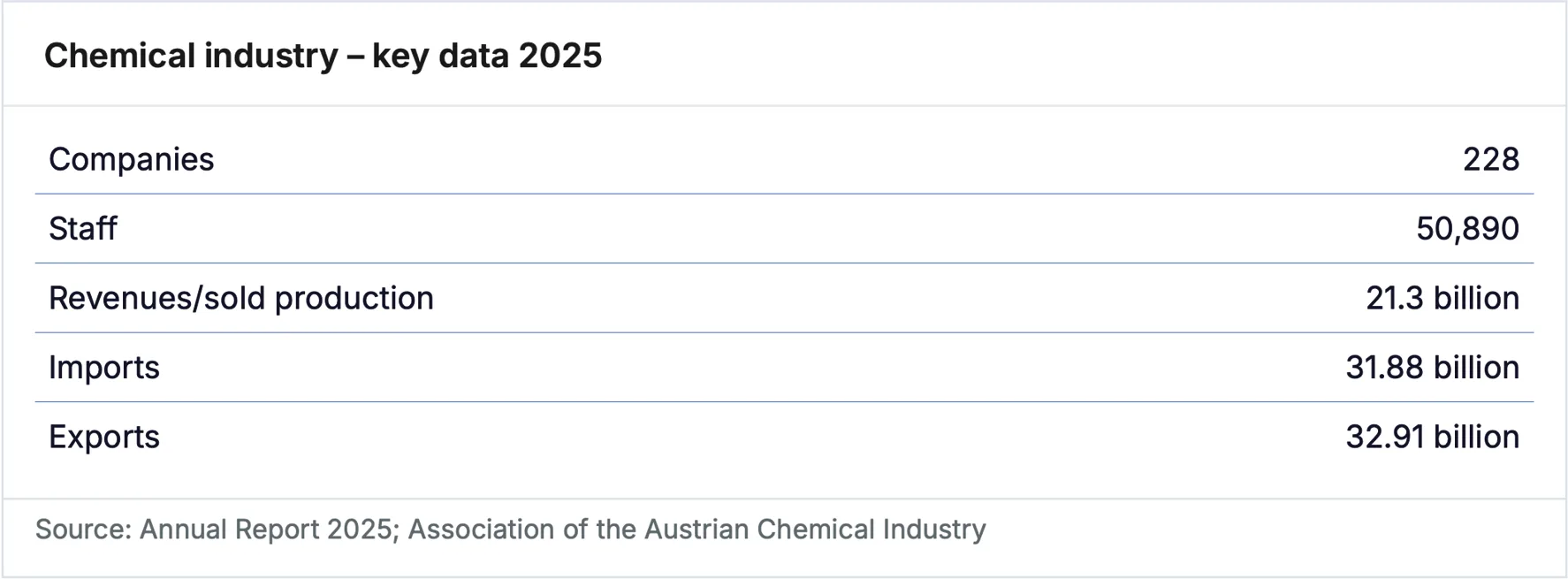
The Austrian chemical industry was able to grow by about 10,7% to a production volume of 21,3 billion. However, it should be noted that the growth was driven by the increase in pharmaceuticals production (plus 31,8%) whilst most other sectors were affected by the economic downturn.
A sector dominated by mid-sized companies
In 2025 the chemical sector comprised 228 companies employing 50 890 people which means a slight decrease of -0,2%. Only 57 companies have more than 250 employees. Chemical companies are distributed across Austria, with key clusters in Upper Austria near Linz and in the Vienna region.
Investment has fluctuated but the trend is down
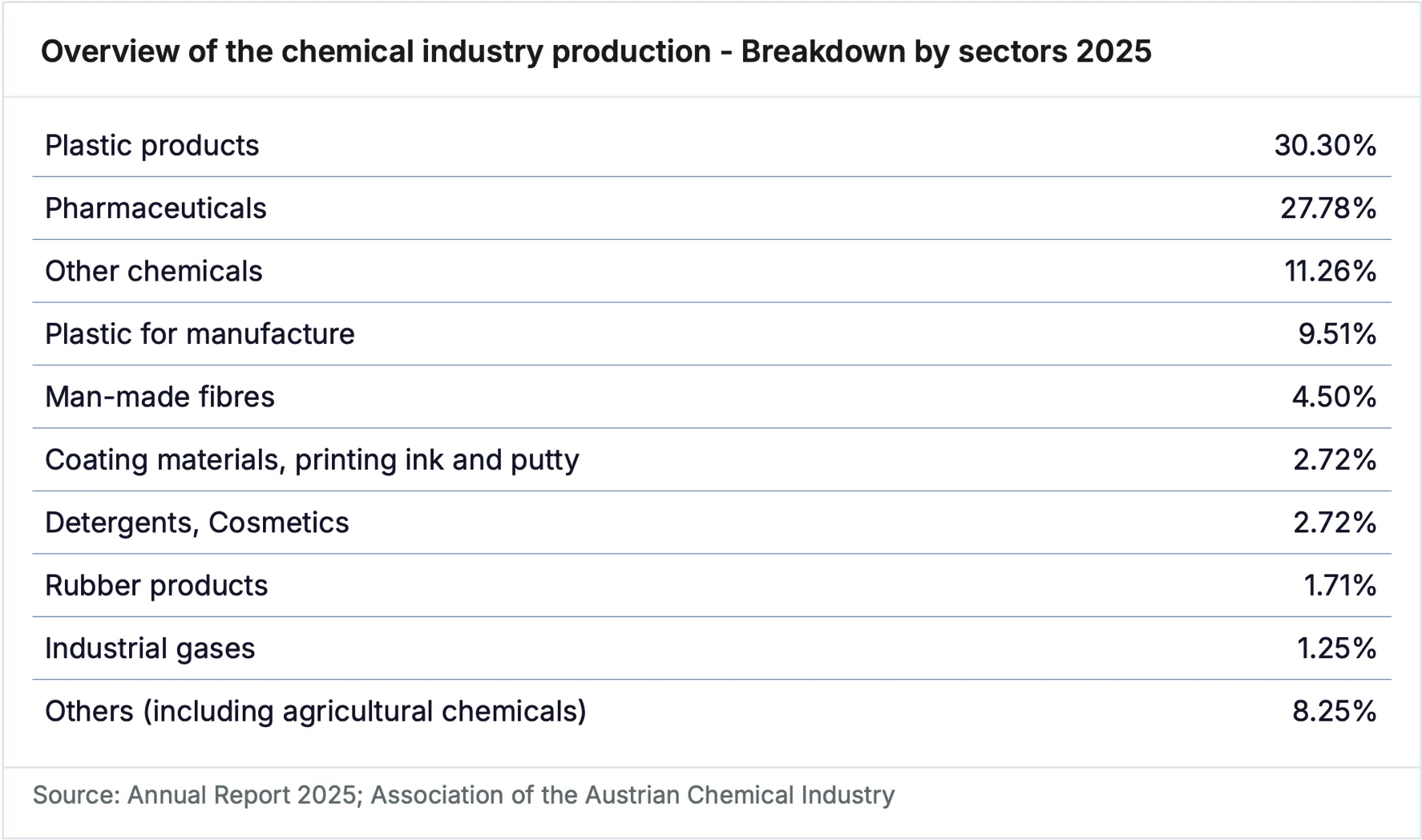
Plastics (raw materials and products) were more than 40% of production by value in 2025, followed by pharmaceuticals (27,8%) chemicals (111,26%) and. Agrochemicals were 3,2%. Over the last ten years, investment in the chemical industry has fluctuated widely and peaked in 2019 and has still not reached pre-crisis level.
How are we doing?
Strengths
- High level of innovation
- High level of specialization
- High level of networking among producers, suppliers and service providers
- Social stability
- Well-educated and trained labour force
- Strategic location at the centre of Europe
Challenges
- Increases in labour costs in recent years
- Demographic trends
- High energy costs
- High administrative and regulatory burden
Our contribution to a competitive Europe
Austria’s Industrial Strategy 2035, adopted in 2026, aims to strengthen the country’s position as a competitive and resilient industrial hub by promoting innovation, sustainability, and technological sovereignty. It defines a long-term vision to place Austria among the top 10 industrial economies worldwide by 2035 and includes 117 measures across seven policy fields, such as innovation, energy, skills, and circular economy.
A central pillar is the targeted support of key technologies (e.g. advanced materials, life sciences, and environmental technologies), which are highly relevant to the chemical industry. Public funding of around €2.6 billion (2026–2029) is allocated to strengthen these areas and improve innovation ecosystems.
Key measures relevant to the Chemical Industry
- Energy cost relief for energy-intensive sectors: Introduction of an industrial electricity price and Extension of the Location Safeguarding Act (SAG)
- Support for innovation & key technologies: Focus on advanced materials, life sciences, and environmental technologies
Expansion of R&D funding, innovation clusters, and technology programs - Strengthening value chains and industrial ecosystems: Development of integrated value chains across industries and targeted support for industrial clusters and ecosystems
- Green transformation & circular economy: Promotion of circular economy and bioeconomy approaches and support for low-carbon industrial transformation
- Improved framework conditions (costs & regulation): Reduction of non-wage labour costs and measures for cutting red tape and accelerating approvals
- Skills and workforce development: Expansion of training and qualification programs in key technologies

