



Europe’s chemical industry is undergoing structural change. Rising production costs, global competition, and import dependence coincide with the need for deep decarbonisation and greater resilience.
A key bottleneck is that many low-carbon technologies remain at pilot or demonstration scale. As a result, new industrial capacity is increasingly built outside Europe, weakening established chemical clusters and value chains. The central question is therefore no longer whether viable low-carbon alternatives exist, but how proven solutions can be scaled into competitive industrial assets within Europe’s industrial base.
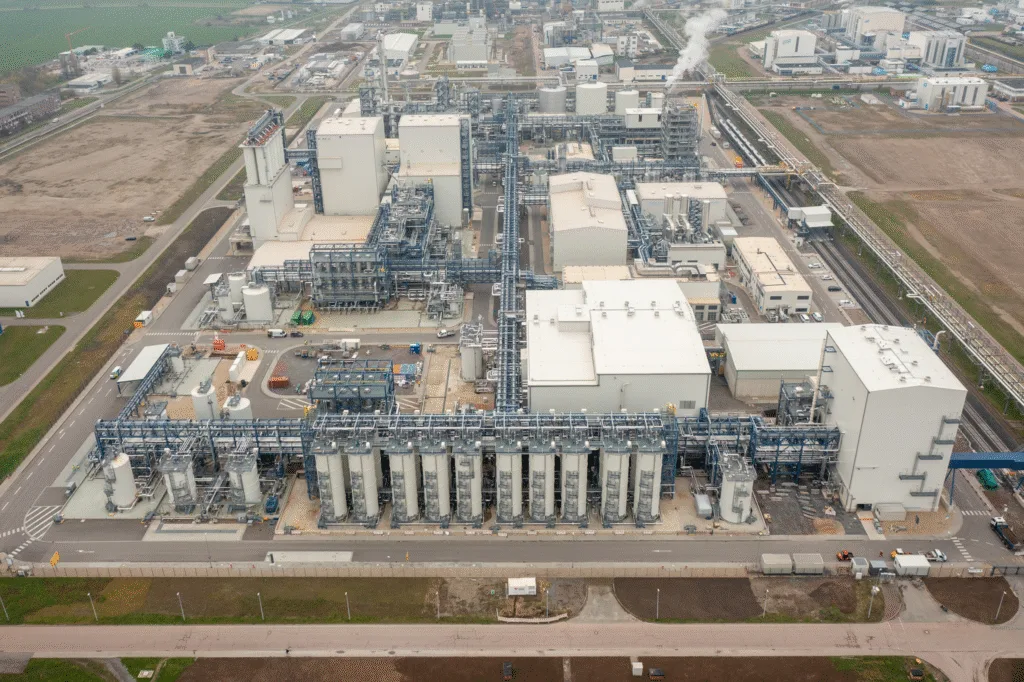
Image credit: UPM
Industrial deployment at scale
UPM’s biorefinery in Leuna is an example of how the bioeconomy can be deployed at scale within Europe’s chemical ecosystem.
With an investment of over €1 billion, the facility converts sustainably sourced beechwood into lignin‑based specialty materials and sugar‑based chemical intermediates, supplying circular carbon inputs to established markets. This enables the diversification of feedstock through the use of circular carbon, without compromising performance requirements.
The location in Leuna, one of Europe’s leading chemical clusters, is central to its model. The site offers integrated infrastructure, established logistics, skilled industrial labour, and proximity to downstream chemical manufacturing. This allows renewable chemicals to be embedded directly into existing industrial value chains rather than developed in isolation.
Reaching full industrial scale proved critical. The investment enabled customer qualification processes, application development, and long‑term supply discussions across multiple sectors. This illustrates how scale and industrial credibility are decisive for commercial adoption.
Competitiveness, resilience and decarbonisation
Beyond enabling industrial deployment, the Leuna biorefinery shows how bio-based production contributes to broader system-level objectives for Europe’s chemical industry. By integrating circular carbon into established value chains, it strengthens competitiveness, enhances supply security through diversified feedstock sourcing, supports the resilience of chemical clusters, and contributes to decarbonisation through industrial use of circular carbon.
UPM’s biorefinery in Leuna converts sustainably sourced, certified hardwood (primarily beech) into 100% bio-based chemicals. Derived from the wood’s cellulose, UPM produces renewable drop-in solutions like bio-monoethylene glycol and bio-monopropylene glycol for use in textiles, packaging, plastics, and coolants without altering existing recycling processes. Lignin is turned into renewable functional fillers, a new material class that replaces carbon black in rubber and plastics.
A scalable model for the European chemical sector
Bioeconomy is no longer a future concept, but an industrial reality when deployed at scale and integrated into existing clusters.
The key challenge for Europe’s chemical industry is replication. The technologies and feedstocks already exist; the decisive factor is creating the conditions to scale proven solutions and strengthen Europe’s industrial autonomy.