Every year, more than 800,000 tonnes of plastic from end-of-life vehicles in Europe are incinerated or landfilled. The automotive industry accounts for around 10% of global plastic demand. Yet despite decades of sustainability commitments, less than 2.5% of plastic in new vehicles comes from recycled sources. The European Union’s End-of-Life Vehicles regulation requires that figure to reach 25% from 2036.
The gap is not technological but a value chain issue that requires rare, large-scale pre-competitive collaboration in the chemical industry.
Automotive plastics circularity
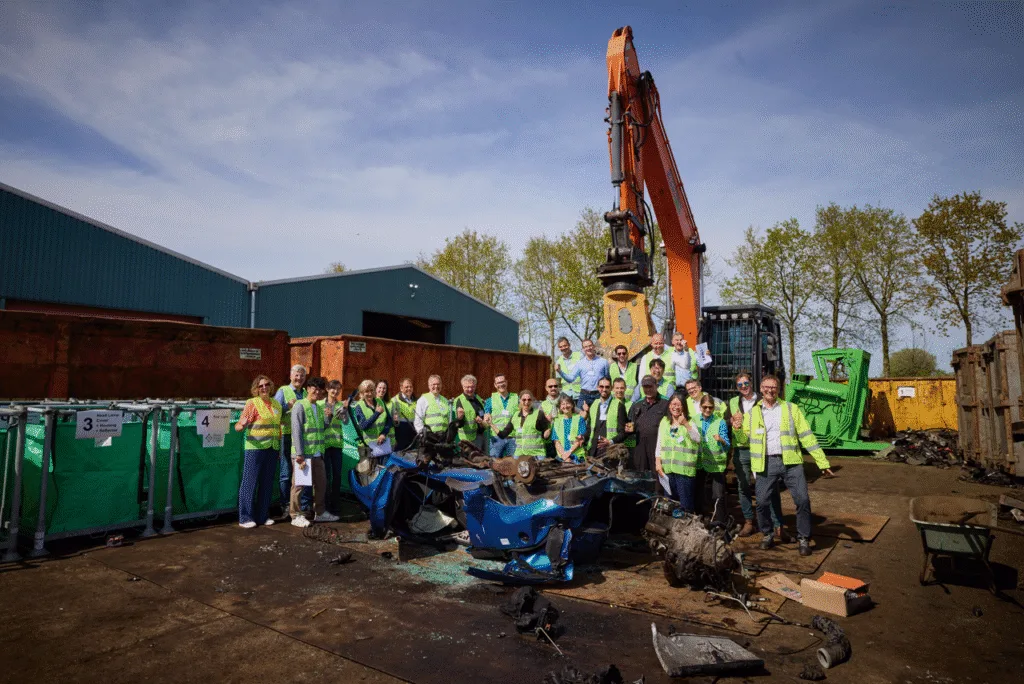
In 2025, the Global Impact Coalition (GIC) launched the Automotive Plastics Circularity project, bringing together eight chemical companies – BASF, Covestro, LG Chem, LyondellBasell, Mitsubishi Chemical Group, SABIC, SUEZ, and Syensqo – to process 100 end-of-life vehicles through dismantling, shredding, and sorting.
The project was designed to answer a question: can plastics from end-of-life vehicles be recovered and processed into recyclable material at real-world scale?
Phase 1 – Finding
The first project report confirms the answer is yes: about eight tonnes of plastic were recovered from end-of-life vehicles of different ages and types. The pilot showed plastics can be extracted, sorted by polymer type (e.g., PP, PET, PC, PU and more), and processed into recyclable material, confirming the technical pathway exists.
However, a commercially viable, scalable value chain does not yet exist.
The barriers are structural rather than technological: Dismantling is complex and labour intensive. Sorting requires significant investment in automation and polymer identification technology. Critically, there is no committed downstream demand – no mechanism that guarantees the recycled material produced at one end of the chain will be purchased and used at the other.
The Phase 1 findings also identified specific technical barriers:
- the diversity of plastic types across vehicle models and ages makes consistent sorting difficult;
- contamination rates vary significantly depending on dismantling approach; and
- the economics of recovery deteriorate sharply without automation at scale.
Phase 2 – The full value chain
Phase 2 represents a structural shift. Where Phase 1 was a chemical industry pilot, Phase 2 brings automotive manufacturers into the collaboration for the first time. Jaguar Land Rover and Valeo – a global automotive manufacturer and a Tier 1 component supplier – work alongside GIC member chemical companies and other industry players including Siemens and Henkel, to address the commercial feasibility of the full value chain.
Original Equipment Manufacturers (OEMs) and suppliers add two critical levers: setting recycled-content specifications in new vehicles and providing the downstream demand needed to finance recovery infrastructure.
Phase 2 focuses on two workstreams:
- building macro and component-level business cases while testing automation, optimized shredding, sorting and chemical recycling to reduce cost and complexity, and
- developing design-for-circularity principles to improve future scalability.
Why collective action is the only path?
No single company can create demand for recycled automotive plastics, redesign dismantling and sorting infrastructure, or restructure the value chain alone. These are systemic problems requiring systemic solutions.
GIC provides a framework for competitors to collaborate without compromising their commercial independence. Members share costs and risks where required, of pre-commercial research, and results, and validate results, data and proof points, onto inform commercial decisions.
The Phase 1 report shows the impact: Eight companies, working together, have generated the first independently verified dataset on recovering plastics from end-of-life vehicles at scale, in a fraction of the time it would have taken any one company alone.
What comes next?
Phase 2 is now underway and the workstreams are active. The question has shifted from whether automotive plastics circularity is technically possible to whether it can be made commercially viable at the scale the market requires.
No single organisation will deliver the answer. It will come from structured pre-competitive collaboration. The full value chain is working on it together, what the circular economy transition requires