




Chemical industry snapshot
Updated with 2025 data
A key contributor to the French economy
France is the second-largest European chemical producer, with a turnover of around €101 billion in 2025 (including active pharmaceutical ingredients), generated by more than 4,400 companies.
Despite a weaker economic environment in Europe over the past three years, the chemical industry in France remains the leading exporting industrial sector in France exporting more than €75bn ahead of the aeronautics and space construction (€68bn) and the food industries (nearly €65bn).
The sector confirms its key contribution to the trade balance of the French economy, with a trade balance of €16bn, second behind aeronautics.
Thanks to its strong presence in many regions across France, more than 4,400 companies, some located at 19 chemical platforms, employ about 179,000 direct employees and an estimated 895,000 including indirect and induced jobs.
Mobilized in its ecological transition, the chemical industry in France aims to significantly reduce its environmental footprint. It is one of the most advanced sectors in its decarbonization trajectory (-70% of CO2 emissions compared to 1990) and a pioneer in reducing water withdrawals and adapting to climate change.
A leading employer
The chemical industry hires and offers high-skilled jobs. In 2025, the sector nevertheless experienced a slight decline in its workforce (-0.5% year-on-year). .
Trends are different across the sub-segments: organic and inorganic chemicals recorded the sharpest declines, while employment rose in specialty chemicals, active pharmaceutical ingredients, and soaps, perfumes and cleaning products. Overall, the sector hired nearly 24,000 people, broadly in line with the previous year.
The level of skills is high with companies offering long-term contracts (94% permanent contracts) and qualified jobs (74% of employees are managers, technicians or supervisors).
Women represent 40% of the total workforce, a slightly increasing share and well above the industry average rate (30.8%).
France Chimie considers work-study training as one of the most effective ways to help the chemical industry renews its workforce and skills. In 2025, the sector hired more than 7,000 alternated students through professionalization contracts and apprenticeships, up 20% over the past five years.
A major international industry
Around 75% of the total chemical sales (including the chemical distribution) were exported in 2025. The European Union remains the leading partner for chemicals in France representing 54% of the total exports ahead of the United States (8%), United Kingdom (6%) and China (5%).
Investing in the future
For the past three years, the chemicals industry in France has been facing a major investment downturn, due to the persistently weak demand, uncompetitive energy costs, and intensifying international competition, particularly from China. Following a historic peak in 2023, investment has entered a phase of sharp contraction.
According to France Chimie’s survey of its members, capital expenditure decreased by 16% in value in 2025 to reach a low level to €5bn.
In an uncertain environment, France’s chemical industry has scaled back its capacity expansion plans by 20% in 2025, held back by limited growth prospects and low-capacity utilization.
Chemistry plays a key role in developing innovative products and solutions that address society’s current and future challenges. This is reflected in the sustained investment in research and development in the sector in France, with a high and constant budget around €2 bn despite the deepening crisis in Europe and the growing competition from other regions, particularly China.
Moreover, France Chimie and Bpifrance, the French public investment bank, are pursuing their partnership to reinforce a “ChemTech” community of more than 250 startups today in the Chemical industry. They represent a major area of innovation and excellence, active in different fields: Bio-based chemistry and industrial biotech, solutions for batteries and electrolyzers, chemical recycling and CO2 recovery, health applications, digital solutions for chemistry measurement, monitoring, process optimization.
Integrated into a network of competitive clusters and chemical parks
In France, about 30 competitiveness clusters have links with chemicals and materials. Six of them are totally or mainy dedicated to chemicals:
- AXELERA in Auvergne-Rhône-Alpes
- BIOECONOMY FOR CHANGE in Hauts de France
- POLYMERIS in Auvergne-Rhône-Alpes
- COSMETIC VALLEY in Eure-et-Loire
- EURAMATERIALS in Hauts de France
- XYLOFUTUR in Nouvelle Aquitaine
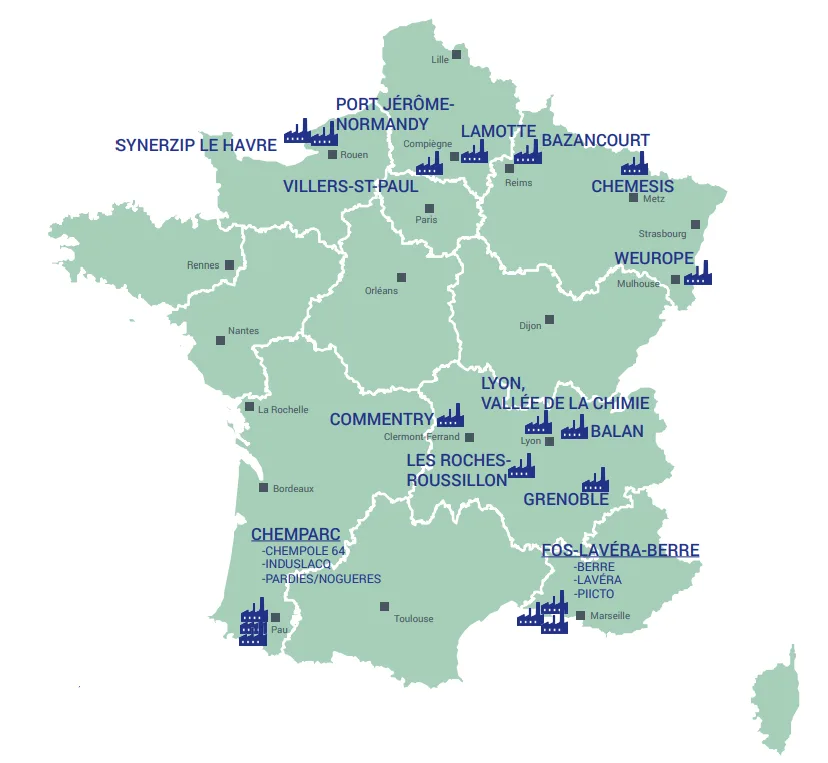
In addition to these attractive clusters in innovation, chemical companies can rely on highly competitive industrial parks. They have access to 19 chemical platforms throughout the country. They are excellent fields for new investments where chemical producers, suppliers and subcontractors come together to pool utilities and services (such as energy production, waste processing or water treatment, process and plant safety, environmental protection, security and fire prevention), covering all activities from planning to construction and operation of chemical plants.
In addition to these attractive clusters in innovation, the chemical companies can rely on highly competitive industrial parks. They have access to 18 chemical platforms throughout the country. These parks are excellent fields for new investments where chemical producers, suppliers and subcontractors come together to pool utilities and services (such as energy production, waste processing or water treatment, process and plant safety, environmental protection, security and fire prevention), covering all activities from planning to construction and operation of chemical plants.
The Chemical platforms in France
How are we doing?
After three years of low chemical capacity utilization in Europe amid a deteriorating economic environment, France’s chemical industry recorded a further decline: turnover fell by 1.3% and the trade surplus by 18%. Upstream activities (organic and inorganic chemicals) were particularly hard hit.
They faced weak demand in Europe and other export markets, along with higher energy and production costs and competition from low-priced imports.
Strengths
The chemical industry in France benefits from key assets which are sources of growth and performance for the global sector, with:
- Large and strong downstream sectors (energy, transport, aeronautics, cosmetics, pharmaceuticals, plastic processing, water treatment, food, packaging, construction etc.)
- High level of integration between upstream chemistry and chemicals intermediates, particularly on the chemical platforms
- Great location and excellent infrastructure supporting worldwide oriented exports
- Outstanding R&D (both public and private) supported by efficient tax incentive programs
- Highly qualified and productive workforce, highly educated young people and an effective training system
- Nuclear energy and low GHG emissions
- Competitive industrial parks or platforms, premises for new investments, pooled resources, such as energy, production or water treatment
- Renowned environmental, safety, security and process expertise
- A strong innovative ecosystem represented by many specialized SMEs (around 95% of the total companies) and a dynamic network of start-ups (ChemTech)
Challenges
- Dependence on imported raw materials and intermediate products
- Image of the industry in general, and of chemical products, upon the French public
- Over-transposition of EU directives in national regulation regarding chemicals and production sites (recent measures taken to remove part of them)
- Increasing tensions on the labour market for both low and high-graduated profiles, especially in the production and maintenance fields. .
Our contribution to a competitive Europe
As a strategic, innovation-driven and high value-added industry, the chemical industry remains a cornerstone of the French and European industrial ecosystem. In France, it brings together more than 4,000 companies, generates over €100 billion in annual turnover, and directly employs around 229 000 people. Its technologies, materials and processes are essential enablers for strategic value chains such as electric batteries and battery recycling, lighter and more efficient vehicles, low-carbon hydrogen applications, advanced polymers and chemical recycling, biobased chemistry, biomanufacturing, semiconductor inputs, additive manufacturing and high-performance materials.
The French chemical industry also plays a decisive role in health security and strategic autonomy. Its contribution includes the production and security of supply of active pharmaceutical ingredients, intermediates and critical molecules, at a time when France and the European Union are seeking to reduce dependencies in critical medicines and strengthen resilient pharmaceutical value chains.
The policy framework has evolved since the immediate post-pandemic recovery period. France Relance helped accelerate industrial modernization and support critical activities such as active pharmaceutical ingredients, biobased chemistry, recycling and innovative materials. This momentum is now being carried forward by France 2030, the Green Industry Act and targeted support schemes for industrial start-ups, first-of-a-kind manufacturing facilities, strategic projects and Important Projects of Common European Interest in areas such as batteries, hydrogen, electronics, semiconductors and healthcare.
In parallel, the European agenda has become more focused on competitiveness, resilience and decarbonisation. The Clean Industrial Deal and the EU Chemicals Industry Action Plan reflect a growing recognition that the chemical sector is an “industry of industries”: it is indispensable to almost all downstream sectors, but it is also exposed to high energy costs, global competition, regulatory complexity and investment pressure. Maintaining a strong chemical base in France and in Europe is therefore a matter not only of industrial performance, but also of sovereignty, climate strategy and supply-chain security.
The energy transition of the chemical industry in France remains a priority for both public authorities and industry players. Having already achieved a major reduction in its greenhouse gas emissions since 1990, the sector is now working towards a further deep decarbonisation trajectory by 2030. Its low-carbon roadmap relies on energy efficiency, access to competitive low-carbon electricity, low-carbon heat, electrification of processes, biomass and circular carbon feedstocks, as well as less mature technologies such as low-carbon hydrogen and carbon capture, utilisation and storage. Key success factors include timely infrastructure deployment, secure access to competitive energy and sustainable feedstocks, and effective protection against carbon leakage and unfair international competition during the transition.
France 2030 therefore confirms a positive long-term framework for the chemical industry in France, provided that public support, private investment and European industrial policy remain aligned. The sector is well positioned to contribute to the ecological transition, reindustrialisation, health sovereignty and the development of strategic technologies, while also requiring a stable, competitive and predictable environment to deliver the investments needed at scale.

