









This project has been recognised as a commendation of the 2025 Responsible Care Awards.
PVC compounds, widely used across industries, are undergoing a transformation to align with environmental and sustainability goals. Thevinyl, a Swedish specialist in PVC compounds, for instance, is integrating recycled and bio-attributed PVC into its production. This approach lowers the carbon footprint of products while maintaining quality, flexibility, and functionality across applications.
A new production era
In 2024, Thevinyl commissioned a new production line, designed with sustainability at its core. This investment doubles the production capacity. In beginning of 2025 Thevinyl added a dosing equipment for automatic dosage of recycled PVC. By using recycled and bio-based PVC, the average carbon footprint, cradle to gate, was reduced from 1.9 kg CO₂eq/kg in 2022 to 1.5 kg CO₂eq/kg in 2024.
Sustainable solutions in action
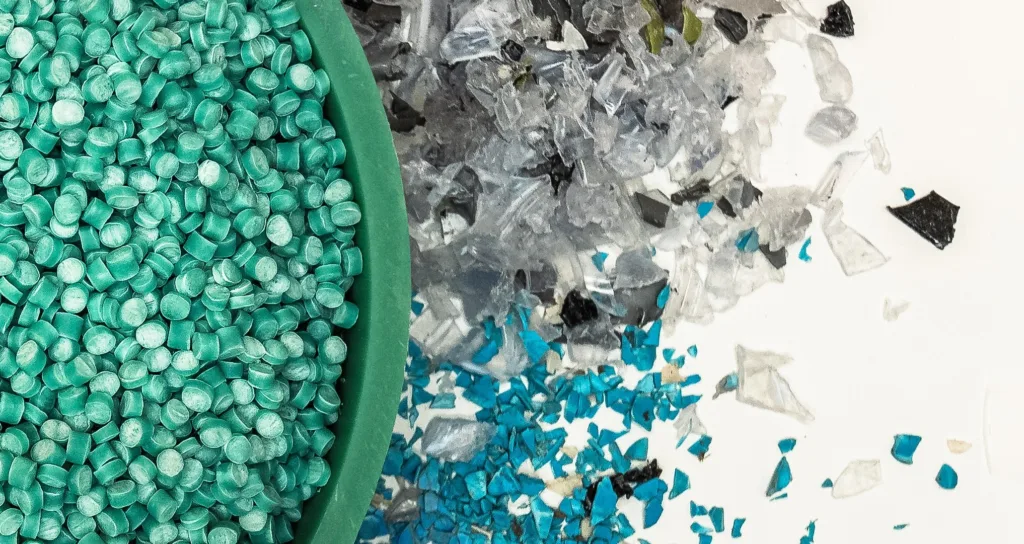
Thevinyl’s sustainability approach extends beyond single products. For multilayer PVC applications, in close cooperation with BOLON flooring, the top layer uses bio-attributed PVC, while middle and backing layers incorporate 100 % recycled rigid PVC. This is achieved through micronisation of rigid waste to allow efficient absorption of plasticizers, a technique not commonly applied in the industry. Micronisation transforms flakes of recycled PVC into a fine powder, where the small particle size plays a crucial role in final quality.
Additionally, recycled fillers are included in formulations, demonstrating a commitment to circular material use. Large-scale applications, such as transparent rigid PVC compounds with 15–20 % recycled content, further highlight the company’s ability to scale sustainable practices without compromising quality.
Benefits and impact
These innovations deliver tangible environmental and operational benefits. Carbon emissions are reduced through alternative materials, while the use of recycled and bio-attributed PVC supports circularity in the value chain. The average carbon footprint of Thevinyls compounds was reduced by over 20% from 2022 to 2024. During 2025 there will be further reduction of carbon footprint by more than 1500 ton CO₂eq mainly due to switching a big part of our PVC resin purchase to NEOVYN from INOVYN. The customers receive high-quality compounds tailored to exact specifications, ensuring flexibility and performance across a wide range of industrial applications in Scandinavia. By combining advanced production techniques, recycled content, and bio-based alternatives, Thevinyl exemplifies how PVC compounds can be produced sustainably at scale.